


I had never worked with exhibits, nor had I ever imagined that one day I would do so. Therefore, when I was called to Turin by the ’61 Italian Committee for the Exhibition of Regions, I thought, that first of all, I ought to learn how.
This, when you really look at it, is always the case: indeed, great painters, great poets, and great artists are all exactly those who, each time when faced with their inspiration, feel like nothing. For them, inspiration is so important that every time, they must reopen the whole question: forget what they know, start everything from scratch.
But evidently, this is their sublime ignorance, their impulses that break down and recreate: they forget and then relearn everything they know, every time. That way, the work is always fresh, genuine, as if free of culture and memory, while it is instead pervaded by them.
This was not my case. Much more simply, there was an entire technique, and a combination of non-artistic but organizational, financial and social phenomena that had to be analysed, made use of, and set in order to achieve this Exhibition. And I was utterly lacking in the real technique of the Exhibition and in all these phenomena that can be called collective and organizational.
So, while I was organizing the Exhibition, I had to learn how.
Unfortunately, an exhibition is not like a novel: an author can write and rewrite as often as he likes. An exhibit is not a work of art. It is a work of popularization, to which many, perhaps all the arts contribute.
And if we must be honest, the show, the exhibition as it was once conceived, is a dead thing, finished.
Other media, from television and cinema to the vast circulation of newspapers and magazines, render exhibits and exhibitions absurd as they were once conceived.
There are two types of exhibits and exhibitions that still work:
- special and limited exhibits: the works of a great painter, a century of painting in a given country, a motor or technical show;
- enormous expository and celebratory series, which include exhibits, but whose true meaning and character does not come from the exhibits – besides, so numerous that no visitor can see all of them systematically, unless they dedicate a month of their life to the task –: their true meaning and character lies precisely this variety, in this quantity, in this combination, in this accumulation of exhibits, shows, performances, entertainment, concerts, fashion shows, gimmicks of every kind. The end result is that they become an enormous and ennobled funfair, composed not of games and amusements, but of shows that are largely immovable, and, at least in their intentions, not only enjoyable, but most of all useful, serious, informative.
The Exhibition in Turin belonged to this second type of exhibit: colossal, touristic, and informative.
The first thing I learned was this: differently from a film or television broadcast, an exhibit of this type cannot be created by one person alone.
Of course, film or television broadcasts also require collaborators. But firstly, they are infinitely fewer in number: fifty at the most for a normal film, and fifteen or twenty for a broadcast.
There are hundreds and hundreds of contributors to an exhibit of this kind. I myself for example, as director of the Exhibition of Regions, had to deal with at least a thousand contributors. Therefore, an exhibit like this one cannot be done by one person alone: absolute and exclusive control escapes him.
Another element that also decreases the dominance of a single person over a large exhibition is the financial factor. Here again, we are not speaking of the capital required to produce a normal film, but a great deal more.
Then there is the variety of techniques required. Some of these, as for example building a pavilion designed to remain, cannot be learned with just a smattering, nor judged by taste alone, the way a scenic effect is subject to the approval of a theatre or cinema director: it must be true experts, builders and architects, who judge these aspects.
And finally, there is the wide variety of organizations interested in the exhibit. In our case, the Exhibition of Regions was an exhibition designed in the climate of regional independence. It would have been ridiculous not to allow each region to make the final decision as they saw fit. A director’s job is limited to provide suggestions, surveillance, assistance, preventing duplicates, and so on.
In this regard, it struck some as strange that the first Centennial of Italian unity was celebrated with an Exhibition of Regions: that is, with a celebration of associated forms of life, of traditions, memories, technical and cultural remnants whose salient function was to negate unity, or at least to contradict it.
Nothing could be more wrong.
But in order for this mistake to be clear to everyone, we must first establish what “national unity” means, or better yet, what type of unity is truly profitable to nations.
Let us draw a comparison. Think of the family. Is not perhaps every country an immense family?
To be true, we cannot imagine a country except in this way. The number of distinct individuals that form a great nation, taken all together, exceeds any possibility of any concrete understanding; it transcends it infinitely. No Frenchman can know every other Frenchman; no Englishman all other Englishmen; no Italian all other Italians.
The only way to escape a false and abstract image of your own country is to compare it, as we said, to a family: a very extended, innumerable family.
So let us reflect. Among the families that we know, we can count some that are apparently very united: their members resemble each other, they agree, they share professions, they have the same character, the same interests, etc. They never fight. A mortal peace, a stultifying relief; a desolate and grey obedience to the same principles; the chill of an obligatory affection; and perhaps a muffled, hidden loathing.
United families, undoubtedly; but unfriendly ones, and above all lifeless and without a future.
On the contrary, we know families in which father and mother, brothers and sisters seem in eternal conflict between themselves and with their parents. It is like a war without respite: no one resembles another, each have their own ideas on every subject, each their own freedom, each their own life. Arguments then, contradictions, rivalries, exasperated statements of individuality, endless battles, which strangely hint at a vast and reciprocal affection, all the more sincere and effective the more unconscious it is, and sometimes even mistaken for aversion.
These are the families we love: the families whose members can be called to great things, the truly united families, joined in the living and working unity that is profound and loving, and so strong that it can allow for outbursts and affectations of some conflicts and differences.
So for example, Great Britain and Switzerland: they are visibly the most unified countries in the world; yet, at the same time, they are countries in which regional, cantonal, and individual freedoms, distinctions, and traditions are the most strongly – I would say most defiantly – defended.
Yes, we believe that after a century of necessary bureaucratic unification, and leaving behind fears of absurd or unthinkable secessions, the secret behind the future of Italy lies precisely in the strength of regional self-governments. We are naturally destined to such self-governments by the great variety of everything around us: climate, landscape, ethnic formation, historic events.
They say that Italy is the most beautiful country in the world. If this is true, the merit lies in its enormous variety as compared with its size. There is more diversity between Bologna and Ferrara at 50 km from each other than between Boston and San Francisco, at 5000.
More varied, and therefore more alive, on the understanding that there is agreement on certain fundamental grounds: that they are free and independent, and that we do not allow anyone, Italian or foreigner, to take advantage of our marvellous variety to weaken us or oppress us.
In other words, now that our political unity is achieved, we must dedicate ourselves to healing the wounds of our imbalances. We must solve the problems in the South; truly undertake the transformation of our economy from agricultural to industrial; truly create education for all until at least 14 years of age.
These questions are all connected, and certainly must be confronted in a “unified” fashion. But true and living unity, as we have seen, is not only not contrary to autonomy for the parties that constitute it, but rather it is beneficial to autonomy and benefits from autonomy.
Only through autonomy, and therefore through a mutual understanding and respect among regions and through a reciprocal support of each for the other, will true Italian unity be achieved and will all of its problems be solved.
Just like the affection and unity of those families who, as we said, are born of their differences, their freedoms, and even their internal conflicts.
How much love, and how many marriages between Northern and Southern Italy, are the result of ethnic diversity and the fatal, inevitable conclusion of a conflict, even of an initial loathing!
“Choose a bird from your own backyard”: a proverb, like many others, directed more to the past and to death than to the future and to life. The loving instinct tells us the contrary: it pushes us toward unknown and foreign creatures, or at least those different from ourselves.
And so, I cannot here go without recalling a sentence… one sentence, one of the endless truths that Father Teilhard de Chardin discovered and published in his volume The Human Phenomenon, a volume that has not yet been published in Italy, but is the new Summa of our new Aquinas.
Here is P. Teilhard’s sentence, which concerns us and which I wanted to use as a motto in every publication for the Exhibition: “In all fields – be it the cells of a body, or parts of a society, or the elements of a spiritual synthesis – unity favours and celebrates variety”.
Teilhard is the philosopher of today. And it is true that before becoming a philosopher, he was a scientist. A great biologist, palaeontologist, and naturalist. In fact, his philosophy is simply science carried to extreme consequences. This is what is new about P. Teilhard. After Copernicus, until him, science and faith were always separate: whether conflicting or in harmony, according to the theories and the men, but always divided. With Teilhard, science and faith are finally one again, as before Copernicus: a single entity.
Has this nothing to do with the Exhibition of Regions and with what I learned working on the Exhibition of Regions?
Oh, it most certainly does. I can say that, having toured Italy three times and having visited every region of Italy three times, beyond consoling myself in my own autonomist ideas, I touched Teilhard’s grand autonomist truth for myself: a truth that refers to the regions, but also to the people, to each individual, and that resolves (in a theoretical sense, of course; Teilhard himself foresees a few centuries for the practical solution – and it is necessary to speak of centuries as soon as you no longer separate science and faith) the rift, which to many appears incurable, and which either way is a terrible, perhaps the most serious problem of the modern world: the rift between justice and liberty, between equality and the possibilities for wellbeing for all people on earth, and the freedom for each of them to do as they please. As we understand, with a view to this problem regional autonomy is extremely important: regional autonomy is, simply, the first step toward this immense and infinite individual freedom, the first step on this march. Unity, in the case of our Italian unity, is no longer under discussion. It is, to use a trendy word, a force of convergence: it is the lowest common denominator of all self-governments, which do not feel themselves diminished, or at least should not feel themselves diminished, by the fact of being part of Italian unity. On the contrary, soon each self-government will understand and will establish that this unity is their very best guarantee (we think again of the Swiss Confederacy and of Great Britain) and, at the same time, the only field, the only way that they have to prosper. Imagine a Switzerland splintered between Italy, France, and Germany, by language: well, what end would come to the self-governments, to the ancient traditions, to the habits, the customs, the countless, ordinary and wide-ranging freedoms that the citizens of each canton enjoy?
The same holds for all nations, and for the regions of every nation in the unity of the United States of Europe: this too, we hope, is not too distant.
And thus, for all people, for all the individual persons in this great unified state of the entire world, to which gradually but inevitably, and perhaps much more swiftly than we believe, we are approaching. Can you see that everything tallies? That everything is moving this direction? Today, we can say that all men communicate with each other.
And the great divisions into opposing blocks? Even this is a sign that we are marching toward a unity of the people of earth: it is easier to join two parts that are already united than a thousand divided, dispersed, anarchic parts, each ignorant of the other.
Finally, here it would be too long too difficult for me to explain the stupendous and comforting new theory from Teilhard de Chardin: but I can repeat comparison that I remember well and which I hope will be very clear.
The individuals, and groups of individual, who join together in a single unique organism, must not fear for their freedom. They must not believe that their freedom should ever suffer from this progressive union with other individual and groups of individuals similar to them. Similarly, says Teilhard, the various convolutions and the molecules and nerve cells that compose the human brain in an inseparable whole can never, each on its own, grumble over this completed union, can never think that this union has in some way diminished their freedom. Because the maximum, the highest, the most unfettered possible use of the freedom of every convolution, of every molecule, of every cell, the maximum possible use of the power and vital freedom of each one, lies precisely in the fact that it belongs to a single human brain.
Therefore, Teilhard says, nothing could be more wrong than imagining the future, through the force of equality and planning, like a great All where drops of water and grains of salt dissolve as if in a sea. On the contrary, it has now been proven, and admitted by all scientists – even the most materialistic and the most agnostic – that the world is moving toward an increasing growth in individual conscience: an increasing growth, that is, of personality. But in the world, everything is centred. Everything moves, and everything rotates around a centre: and an awareness, every awareness, is that much more itself, moves that much more, feels that much more free, the more centred it is. That is, the more it converges toward a single centre, an operation that is being executed, in the meantime, by all the other awarenesses.
The grains of awareness, then, the awarenesses of the individuals and groups of individuals converging progressively around this centre never tend to lose their edges and blend together: on the contrary, they accentuate the depth and incommunicability of their ego. The more they become, all together, a single organism, the more they find themselves.
In any organized whole, the parts become more perfect and are complete. It could not happen otherwise: because a centre – a CENTRE – never dissolves. And the sole image, as Father Teilhard says, “…the sole image with which we can imagine ourselves and try to exactly express that final state of the world, which is on the path of concentrating psychically, is a system whose unity coincides with a paroxysm of harmonised complexity”.
And the direction of this evolution, the driver of civilization and history: what is it?
It is the most essential thing, physically, in the celestial body that brings us. It is spirit itself. It is life. To understand it, simply study zoology: from one zoological genre to another, something passes and grows, by great leaps, never stopping, always in the same direction.
The same way that, traveling in Italy to organize the exposition of the nineteen regional pavilions, I realized more deeply and increasingly well these supreme truths that the genius Teilhard has arrived at, comparable only to the truths discovered by Copernicus and Galileo, but superior because, as I said, they identify science with faith, the laws of physics with a spiritual principle: in the same way, in organizing a “unified pavilion” that illustrates to the public the first hundred years of our political unity, I can say that I have, within myself, lived the same experience of the teaching of Henri Bergson, the French philosopher who without a doubt was the teacher of Teilhard, or at least of Teilhard the philosopher.
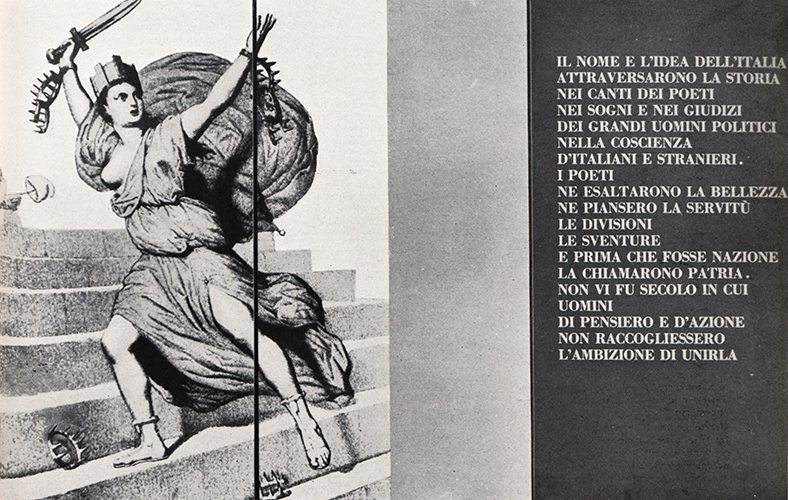
Even here I’ve learned, doing this show, much more than reading books. Because I have put the excellence of these theories to the test. And if for the nineteen pavilions it was a journey – actually it was three journeys – through all of Italy, for a unified pavilion it was a journey through time. From today to 1861, a journey across a century, and across everything that could document a century of Italian history: writings, books, memories, speeches, studies, images, paintings, drawings, architecture, everything.
And what in fact is civilization, if not a phenomenon of memory? And what is the education of a man, if not the memory of the experience of his forefathers, his ancestors, of all those who preceeded him on this Earth? And what is a country then, if not its history?
We asked ourselves these questions, before any others, naturally, when we accepted the task of commemorating the first century of Italian political unity, and to commemorate it not only with the Exhibition of Regions in nineteen regional pavilions, but also with a pavilion whose task was, in some way, to represent for the visitors this first hundred years, of “unity”.
There were infinite solutions before us, but it was immediately clear that we could reduce them to two major groups: the first group included all the ways of dividing by subject, that is, politics, art, armed forces, sports, and so on; the second group, however, included a few methods of dividing by time, meaning years, half decades, decades, twenty years, or even other longer or shorter periods, delimited more or less artificially by crucial events.
After lengthy consideration, we realized that it would be a mistake to decide absolutely on one system or the other: because the reality of history consists precisely of the relentless weave of time and ideas; of the growing weight of each year and each day of this century, of each idea; on the ever less limited memory, on the ever less superficial awareness, from 1861 to 1961, that Italians had of Italy.
In other words, if we didn’t want to content ourselves with an ordinary, tiny, myopic chronicle, and thus forgo any judgment, we needed to face dividing the material into subjects, but also, at all costs, to ensure that visitors did not retrace the course of the century fifteen or twenty times because they are so many subjects: we needed to contain these cages within a larger cage. We needed to somehow lay the presence of time over all the other presences.
We then found that the subjects could also be divided into two large groups.
On the one hand, phenomena of institutional life, such as education, journalism, the arm forces, politics, the formation of the capital city: that is, all phenomena that depended strictly on political unity, and that therefore could not be studied together before 1861.
On the other hand, there were the phenomena of technical and cultural life: art, entertainment, sports, economics, communications, etc.; fields in which Italy had been united, or tended toward unity, for centuries, meaning at least since the age of the City Republics.
Thus, a dual pathway was conceived. And, so that this duplication would not be bothersome in itself, the direction of the two sections was conceived to be inverse; institutional life moving back from present to past, and technical and cultural life from past to present, both converging toward the unity of Italy sung by Dante and Petrarch and prophesied by Machiavelli: an ancient and profound unity, which should have its place and its representation beyond the history of these last hundred years, being both its cause and its condition.
In any event, then, we retraced from the present into the past.
But is not perhaps this and not the opposite the most natural way of thumbing through a pack of old letters and photographs that we have accumulated little by little, one atop the next, season after season, year by year, in a useless box or in the bottom of the farthest desk drawer?
Photographs, photographs: exactly, like an old family album. Photographs; flat and faded, now, like our memories. But which, very wrongly, we believe to be of no use, while they are instead all of our wealth: the symbol of what makes us alive today.
It is precisely to acquire awareness of our current life that we have thumbed through this enormous old family album.
How many names, forgotten or nearly, come back to us! How many of these names took on a figure, a face! And the youngest visitors, did not they stop, were not they curious, did not reflect that life yesterday was not less vigorous than ours, nor less worthy of being lived, if not only because without her our own would not have been? Did they not understand that, like the problems of the Italians of today, those problems that often seem mysterious or far from any solution, are identical to the problems of the Italians of yesterday and on back?
Of course, we thought above all and against all of commemorating the first hundred years of unity with an informative exhibition: this, because we are certain that the young, above all and against all, want to know, and that our first duty is to inform them.
In fact, the world changes and progresses only because the human brain is capable of remembering.
Time is not a homogenous quantity, like so many grains of rice or beads on a rosary. This is the Bergson’s great lesson: the qualitative examination of time. A year, a day, an hour, a minute, a second: they are never identical to the previous second, minute, hour, day or year. Each moment that passes is always richer, stronger, weightier and more alive than the moment before: because it contains and encloses not only itself, but also the memory – all the possible memory – of the previous moment and all the past moments back to the farthest distant at the beginning of time, that is, memory.
If all this is true, no contribution to the civic progress of our country is more powerful or more worthwhile than historic studies. An ordinary and living historical documentation, an historical education extended to all citizens without distinction, an historical instruction that won’t let any broadly informative or popular opportunity slip by: this was our opportunity with the Turin Exhibition. We have an example in this regard, a painful example, but one which almost seems invented for the purpose, so we might understand beyond any doubt, and with a dazzling clarity, the importance of history and memory: we have the example of the gypsies.
This strange people, fixed, immobile through the centuries and their wandering, almost atrophied: this people without memory or history, or with a memory and a history so distant and so immobile as to have become a religion, a complex of superstitions and rites whose meaning is incomprehensible to even the gypsies themselves. This people does not evolve because it does not remember, but merely venerates and exorcizes; this people, a terrifying vision of involution and death. This people, which still we love and would like to restore to life, to history, and which one day certainly we will restore, but which meanwhile we cannot help but take as an example of everything we must avoid.
This people does not believe in history and does not believe in society. It does not believe in others, it considers itself detached and damaged, or detached and blessed, but in either case different and detached, not participating: and it considers others, the world, as merely means to exploit, with cynical nonchalance.
This people does not believe in culture, except, possibly, as a tool for making money.
This desperate and closed people would be worth an in-depth and scientific investigation. I am certain that among them we would find typified and shown with infallible precision all the defects, wrong ideas, idleness, condescension, and troubles that slow all the peoples of Earth, even the most modern, even our own, on the path of evolution.
We would find in the gypsies the example, and nearly the paradigm, of that egoism, of the closure into one’s clan and one’s selves, of that immobility, of that recoiling from the natural drive of evolution: the drive that converges toward a unified centre, and by so doing, celebrates the personality of every point, precisely in the continuing and increasingly keen search for that centre.
Here that memory, like true unity and true autonomy, fall within this concept of evolution illustrated by Bergson and Teilhard.