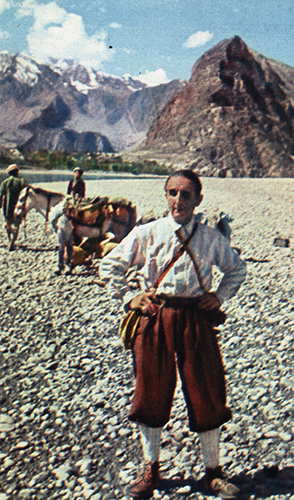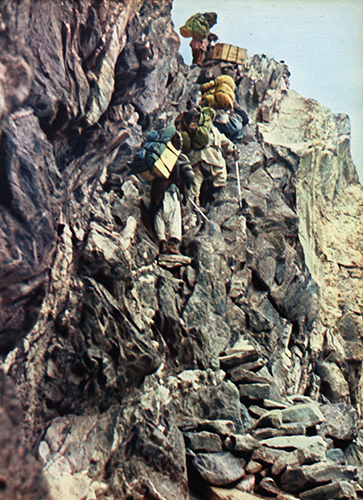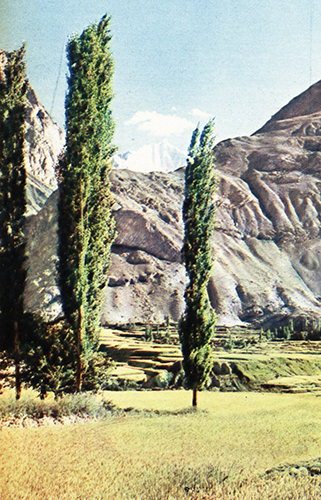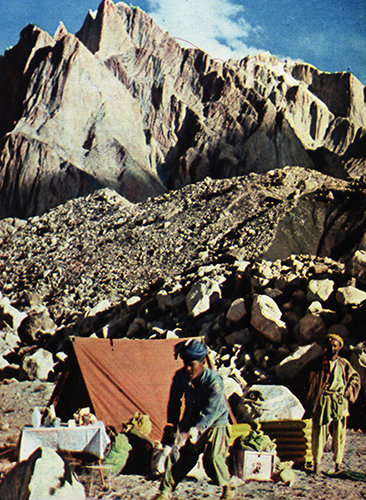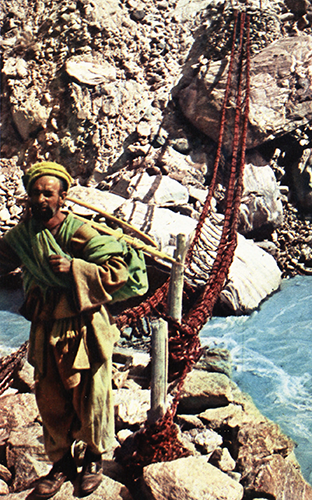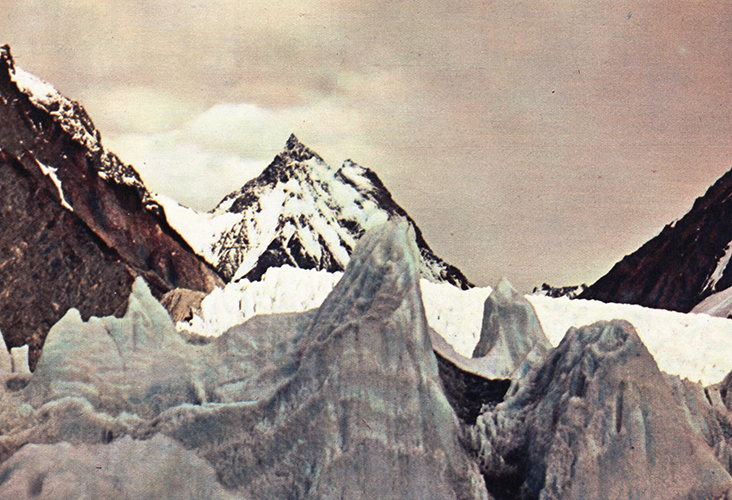



The colour photographs accompanying this article by Dino Buzzati were taken during the last reconnaissance expedition undertaken by Prof. Ardito Desio in the region of the second highest peak in the world
Of those nations that have a great mountaineering tradition, Italy was perhaps the last to conquer the peaks of the Himalayas. Obviously, if successful, the expedition that is setting out to conquer the K2 – the world’s second-highest peak – will be sufficient to compensate for any regret over lost time.
In the period following the Second World War, Alpinism showed a net change in direction worldwide. Having resolved all the challenges of the Alps, the youngest and strongest climbers aimed to conquer the most challenging peaks in other continents, and the problem of scaling the highest Himalayan mountains seemed almost insurmountable.
Apart from an expedition to the Andes where the endless talent of the Italian Piero Ghiglione brought great glory to his country (although there are still many entire peak systems to be explored in that range) and the formidable success of the French in scaling Mount Fitz Roy in Patagonia, undoubtedly one of the most beautiful and challenging mountains in the world, in those years the ambition of Alpinistic countries focused on the “eight-thousanders”, the term used for those peaks higher than 8,000 metres and constituting the supreme crown of the world.
There are 14 eight-thousanders known today – it is highly unlikely that others will be discovered – and all are found in the Himalayas: in order of altitude, they are Mount Everest, 8,888 m; K2, 8,611 m; Mount Kangchenjunga 8,579 m; Lhotse, 8,501 m; Makalu, 8,470 m; Cyo Oyu, 8,189 m; Dhaulagiri, 8,167 m; Manaslu, 8,135 m; Nanga Parbat, 8,120 m; Annapurna, 8,075 m; Gasherbrum i (Hidden Peak), 8,068 m; Broad Peak 8,047 m; Gasherbrum ii, 8,035 m and the Goisanthan at 8,018 m.
In the post-Second World War period, the following expeditions were organised to these mountains: following their first attempt to scale Mount Everest (Shipton Expedition) in 1951, the British finally succeeded in reaching the summit last year (Hillary and Sherpa Tenzing, Hunt Expedition); the Swiss also attempted to scale Everest twice in 1952, and reached 250 m from the summit (Lambert Expedition); the French who scaled the Annapurna in Nepal in 1950 were the first to scale an “eight-thousander”: the Germans scaled the Nanga Parbat (Hermann Buhl alone) last year, the same peak where they had previous lost ten of their finest mountaineers in 1934 and 1937; last year the Japanese tried a massive but unsuccessful effort to climb the Manaslu; last year the Russians too made a failed attempt to scale Everest from the North face (resulting sadly in the death of more than one member of the expedition); finally the Americans in 1953 made an unsuccessful attempt on the K2 (Houston Expedition).
We could say that the current situation in the Himalayas is similar to that of the Alps in the first half of the 1800s, a period in which most of the highest Alpine peaks had not yet been climbed, and the search for the most difficult route had not even been started. For the Himalayas, this situation will last for quite some time. If one thinks of tackling this or that approach or scaling a certain crag or crevice then we have an almost infinite horizon of possibilities. “We have our work cut out for us for many centuries”, said Marcel Kurz.
It is superfluous to add that this type of mountaineering is different from what we find in Europe. An ascent by two friends who leave the city, perhaps with a little money in their pockets, and after two or three days return home after doing a “Grade vi” climb is for the moment impossible in the Himalayas. Those mountainous regions have no towns like Zermatt or Courmayeur and are totally lacking in mountain shelters with basic services. Every single expedition must be organised from scratch, and this costs tens and tens of millions [of Italian lira]. Often, tedious diplomatic negotiations must be conducted with the governments of India or Pakistan to obtain the necessary permits, and this is not because of any bureaucratic officiousness but because these high mountain valleys are poor in resources and men, and the contemporaneous arrival of two expeditions can create great inconvenience. Nepalese Sherpas or at least local porters have to be paid to free the climbers from any heavier tasks; careful planning of the expedition, including a series of base camps, staging camps and supplies is required to ensure that the advance party can launch their final effort to reach the summit from the most convenient starting point possible and conserve their energies for the final run. A hefty dose of good luck is needed due to the changeable weather, which usually concedes two favourable periods, one in the summer and one in early autumn, and even these periods last just a few days; gradual acclimatisation is necessary due to the rarefaction of the atmosphere above 7,000 m, which is probably the greatest difficulty encountered; in the case of snowstorms, one must resist the sense of desperation or isolation that can overcome even the most hardened climber, and which is exacerbated by the physical weakness caused by altitude; single members of the expedition have to renounce any personal ambitions that may jeopardise the safety of the group. All of this without so much as considering the intrinsic difficulties of the ascent itself, which puts both the physical and moral faculties of the climbers to the test, even when from a technical perspective the individual climbs might be no more than Grades ii or iii.
Let’s now consider the prospect of our endeavour.
For those who want to know what K2 entails, Riccardo Cassin who accompanied Prof. Ardito Desio last summer on a preparatory journey to the Baltoro Glacier replied: “It’s like twice the Cervino”. The comparison with the Cervino is no understatement, especially when we consider the analogous comparison between Mount Everest and Mont Blanc. Mount Everest is less steep than K2, just as Mont Blanc is less steep that the Cervino. The ascent of Everest requires long and complicated crossings of glaciers and icy ridges or seracs, whereas for K2 – like the Cervino – no such skill is needed, as the pyramid-like mass rises rapidly from the Godwin-Austen Glacier below, presenting little difficulty, as it is almost flat. Furthermore, K2 and the Cervino soar upwards towards the sky, with sheer, cyclopic drops on all sides. The same comparison is valid also for the level of difficulty, because undoubtedly the K2 is more difficult than Everest.
Apart from these difficulties and the terrifying grandiosity of the faces to be scaled – with an elevation gain of over 3,000 m – there are some favourable elements. Firstly, the ascent route for the south-east crest (all other routes are considered much more difficult, if not impracticable) follows a ridge which dramatically reduces any danger of avalanches. Furthermore, there are no more unknown difficulties to be overcome given that the American Wiessner – although unable to reach the summit – resolved the most complicated mountaineering problem in the steepest part between the shoulder and the crown of the summit.
It would take too long to tell the entire mountaineering history of K2, and to cover in detail the various events and occurrences, but in brief:
- in 1861 the head of the Trigonometrical Survey of India, Godwin Austen, first approached the base of K2 (this mountain is also named after him);
- in 1902 the Guillarmond-Wesseley Expedition composed mainly of Swiss nationals attempted to scale the mountain, but did not get beyond an altitude of 6,800 m;
- in 1909 the Duke of the Abruzzi, with the guides Joseph Petigax and his son Lorenzo, Henry and Alessio Brocherel, the porters Emilio Brocherel, Alberto Savoie and Ernesto Barreux, took on the south-east crest, which has since been known as the Abruzzi Spur due to “delta-like” shaped formation of the buttress (fourth from the left), but were forced to abandon the attempt when they reach an altitude of 6,700 m;
- in 1938 the American expedition headed by Charles Houston attempted the same approach from the same point that they reached with seven staging camps. They reached the summit of the crest at the level of the so-called “shoulder” where they stopped at an altitude of 7,925 m at the base of the final ice and rock wall, which has an average gradient of 65 to 70%;
- in 1939 another American expedition with nine staging camps managed to go beyond this ice and rock wall (roped party Fritz Wiessner and Sherpa Pasang Lama) to reach an altitude of 8,370 m. The two climbers had to turn back because night fell; the following day they attempted the wall again but encountered an icy couloir which would have taken too much time to climb; they then met with tragedy because one of the porters had communicated erroneously downhill that the advanced party was lost. In the light of this tragic news, the lower staging camps were dismantled, and following another series of accidents too long to explain in detail, the American climber Wolfe and three porters perished;
- in 1953 Houston once again took on the mountain but met with bad weather and was not even able to reach the altitude of his 1938 expedition. On the return route, the geologist Gilkey suffering from phlebitis was killed by a snow slide whilst he was being lowered downhill.
The initiative
The first official steps towards this Himalayan initiative were made a little more than a year ago when the Board of Directors of the Club Alpino Accademico Italiano – the prestigious child of the Club Alpino – gathered after undertaking a rigid screening of the finest non-professional Alpine climbers and decided to evaluate the feasibility of a Himalayan expedition, but still there was great uncertainty and even the final destination was unknown.
Fortunately, one man had already taken the preliminary steps to obtain the required permits from the local authority – an indispensable step, as without this, determination, capacity, courage, organisation, and resources would have been completely pointless. This was Prof. Ardito Desio, member of the Accademico, director of the Geological Institute of the University of Milan, mountaineer, scientist and internationally renowned explorer. Due to the great demand from countries vying to be granted the necessary authorization (permits for Mount Everest had already been granted), Desio, on account of his first-hand knowledge of the Karakoram he had already explored with the Duke of Spoleto in 1939, and also his desire to confer to Italy an important success of worldwide renown – only slightly less than that which an Everest summit would grant – had been focusing on K2 since 1952. He made direct contact with the authorities in Karachi and although he received their reassurance, nothing had been definitively confirmed. His personal prestige and diplomatic efforts were sufficient, however, to ensure authorisation from the Pakistani authorities, something that many other countries were trying to obtain at the same time, in particular the Americans who believed themselves to have a right to K2 following their 1938, 1939, and 1953 expeditions, as did the Germans who had already stated publicly that the K2 was the next summer’s objective for their team led by the guide Mathias Rebitsch.
Official authorisation for the ascent of K2 in 1954 was received quite late, in the month of October 1953. This delay gave very little time for preparations, and certainly more time would have facilitated the planning which was undertaken in haste, but still with great care and attention.
The following is a summary of the organisation: The promoters of this initiative were the Consiglio Nazionale delle Ricerche [Italian Research Council] and the Club Alpino Italiano. The National Olympic Committee were also interested in the initiative and had approached Desio previously to organise a similar expedition. Heading the expedition was Prof. Ardito Desio himself, who also chaired the Organisational Committee composed of various eminent persons from the world of Alpine climbing: Mr Guido Bertarelli, Count Aldo Bonacossa, the lawyers Renato Chabod and Alessandro Guasti, Amedeo Costa, and Mr Vittorio Lombardi, Mr Guido Rivetti, Mr Silvio Saglio, Senator Attilio Tissi, and Count Ugo di Vallepiana; people of such competence as to guarantee the success of the initiative. In addition, 10 sub-commissioners were appointed from the world of science, medicine, industry, and mountaineering. Their task was to prepare all equipment, medical check-ups and physiological examinations of the candidates as well as to guarantee adequate financial resources.
In mid-December Desio convened 21 academics and Alpine guides in Milan as potential candidates for this great expedition. In a lecture hall in the Institute of Geology in Via Botticelli he outlined the criteria adopted for the selection process and gave a brief outline of how the expedition would be undertaken. 10 participants were to be chosen from this group of 21 candidates; in addition to the leader of the expedition, the physician Dr Guido Pagani – also member of the Club Alpino Accademico – and five scientists would accompany the group.
The first phase of organisation was already underway in October, and the selection process of the participants started towards mid-December with a series of medical and physiological examinations of the candidates in various institutes of the University of Milan. Further physiological tests were carried out in Turin with the simulations of environmental conditions at 8,000 m and above. From the 17th to the end of January the climbers that had passed these examinations – despite the little time available, these tests were conducted rigorously, and perhaps similar tests were not conducted for the participants of the British expedition – underwent an acclimatisation simulation in a camp at 3,700 m, on the Pian Rosà glacier between Testa Grigia and the Gobba di Rollin above Cervinia. Here the men could test their resistance to high altitudes, the cold and exhaustion, but also experiment with the new materials, the various clothing and footwear, isothermic tents and other types of equipment such as the portable pulleys and oxygen masks. These nine days of camp and trials gave invaluable technical feedback, beyond providing the ideal opportunity for the candidates to start getting to know each other.
All preparations will be completed towards mid-February with a second experimental camp on Monte Rosa at 4,200 m where the participants will undergo preliminary acclimatisation and familiarise themselves with the use of the oxygen masks and other equipment to be used in the Himalayan expedition. Training and acclimatisation will be finished by mid-March, then the equipment will be packed, loaded on ships and transported from Genoa.
Although the preliminary schedule may undergo some minor changes, at the beginning of April the second phase of preparation will start with the transfer of equipment and people in different phases between Italy, to the base camp at the foot of K2 at an altitude of approximately 5,000 m.
Most of the participants will travel to Karachi by plane, and then on to Rawalpindi by rail, from there to Skardu by plane and then on foot to Askole and Urdukas for an initial period of acclimatisation, training and testing of equipment.
Finally, from the 1st to the 5th June, the climbers will move to the base camp, allowing a second period of acclimatisation until mid-June while some of the materials and equipment will be transported to the start of the Abruzzi Spur which will be the starting point to launch the attack on K2.
And now to the crucial phase. From mid-June to the 25th July, the final ascent will take place after the setup of nine staging camps, so that the advanced party will not need to undergo extreme elevation gains in the final part of the ascent. Should bad weather be encountered in those weeks, a second attempt will be made in the period from 25th July to the 20th of August, but the team members hope that this second attempt will not be required.
If the first attempt is successful, the team will return to Italy in mid-August, whereas if a second attempt is necessary, they will return in September.
The head of the expedition
The Friuli-born 56-year-old professor Ardito Desio is a slight, thin man with an aquiline nose and a cordial and smiling countenance. Chair of the Institute of Geology of the University of Milan, aside from his notable scientific work, he has also participated in many expeditions: the Alps, the Dodecanese, the Karakoram (accompanying the Duke of Spoleto in 1929 as geographer and geologist), in Persia (where he explored the Zard-e Kuh chain, and completed various first ascents), the Libyan Sahara, Tibesti in East Africa, and Albania. He is a member of the Club Alpino Accademico Italiano and aside from his specific skills in mountaineering, he has practical experience in resolving difficulties typically encountered during expeditions in remote, inhospitable areas in which solitude prevails and every minute detail must be calculated meticulously beforehand. Thus, he possesses all those formal qualities to head the K2 expedition. But what is most reassuring and confirmed by people who have met him is his extraordinary vitality and energy. Although no longer young, he gives the impression of being indefatigable and is always endowed with great serenity and calm; his perennial optimism prevails even in situations of unexpected difficulties or problems. Some people have compared him to Jules Verne, a rather apt comparison if we disregard the evident difference in age between the younger Desio and the fictional Verne. With his perennial youthful outlook, which is not a mask, but corresponds to a vivacious and sociable temperament, it is easy for those who have met him to understand his solidity of character. Though we are, as all experienced mountaineers, difficult to please and fast with our criticism, still we felt no hesitation in putting our complete trust in Desio to lead the K2 expedition. In brief, for his capacities, experience, clear vision, and leadership skills, he appears to be the ideal man for the task.
The team
The selection of the team was made with great diligence and calm. Some candidates, however, strangely considered their not being selected part of a team for an ascent of over 8,000 m as some kind of moral or physical capitis deminutio. To clarify this point, there are many men capable of taking on the most arduous “Grade VI” ascents in the Alps who are not able to take on such extreme altitudes; this is not because they lack courage or determination but merely due to a physical factor. This physical incapacity is relative, because all the first candidates were of the highest level and any exclusion cannot be interpreted as a negative evaluation on their capacities or stature as mountaineers.
There were some discussions, especially regarding the exclusion of Riccardo Cassin, who was undoubtedly the most renowned exponent of Italian mountaineering. It is absurd, however, to consider any negative evaluation by medical experts to be based on a negative judgement of the technical or moral qualities of the candidates. Being a serious person, Cassin himself immediately realised this when he read the “expert reports” stating that he was not suitable to be part of the expedition. No other negative issues were encountered except that he was considered less physically efficient than the other candidates.
The decision to exclude Cassin from the expedition was a very difficult task indeed for the Organisational Committee. Desio had expressed that having someone of his calibre on the team would have been a guarantee. Going against his scientific background, Desio thought that despite the physiological results, a person such as Cassin could still perform excellently, even at an altitude of 8,000 m, but it was difficult to take on such responsibility. What if in a critical moment Cassin’s physical deficiency were to put him in a condition of inferiority or difficulty? The discomfort of even one person in those conditions – for example, the 1939 Wiessner expedition, and last year’s Houston expedition – could have catastrophic or even tragic consequences.
Having clarified this point, the next step was to take the selected candidates to the second camp (11 men, one of whom had to be excluded) with the proviso that until the day of the departure more changes could be made to the team, which was composed as follows:
Enrico Abram, 31 years old, from Bolzano, Alpine guide and renowned Grade VI Dolomite mountaineer.
Ugo Angelino, 31 years old, from Coggiola (Vercelli), academic.
Walter Bonatti, 24 years old, from Bergamo, academic, known for having climbed the Grand Capucin face of Mont Blanc.
Achille Compagnoni from Sant’Antonio Valfurva, an Alpine guide in Valtournenche, 39 years old.
Cirillo Floreanini, academic from Cave del Predil (Udine).
Pino Gallotti, 34 years old, engineer, academic, President of the sucai.
Lino Lacedelli, 30 years old, Alpine guide, one of the most daring “squirrels” of Cortina d’Ampezzo.
Mario Puchoz, 35 years old, Alpine guide from Courmayeur.
Ubaldo Rey, 30 years old, Alpine guide from Courmayeur.
Gino Soldà, Alpine guide from Recoaro, 46 years old and one of the most famous Grade VI climbers, being also the first to climb the south west face of the Marmolada.
Sergio Viotto, 25 years old, Alpine guide from Courmayeur.
The scientific group that was to travel independently was composed as following: Dott. Bruno Zanettin, petrographer, Prof. Antonio Marussi, geophysicist, Col. Enrico Ceccioni, topographer of the Istituto Geografico Militare and Capitan Francesco Lombardi, topographer, and an anthropogeographer who has still to be identified.
As previously stated, the medical expert of the expedition was Dr Guido Pagani, an academic.
Equipment
Obviously, the previous Himalayan expeditions by the Swiss and the British proved invaluable because both national teams in a spirit of great camaraderie provided all information and details requested by the Italians.
The isothermic tents with a double external wall to create an isolating layer were built in Italy.
Clothing for high altitudes was not very different from those previously used by the British and the Swiss: “down” jackets, commonly known as “duvets” stuffed with feathers and made of very light but insulating fabric.
Boots similar to those of the Swiss team were used: double leather soles stuffed with opossum and completed with a type of gaiter reaching just below the knees. The boots used by the English expedition were made of very light material and were judged by Col. Hunt to be too fragile and easily broken. The boots used for altitudes less than 7,000 m were also fur-lined.
Following detailed studies and examination of previous experiences, an open-circuit type was adopted for the respiration masks using also atmospheric oxygen and built in Italy with some modifications to the Swiss or British models. The British team had used three types: a closed-circuit mask previously used by Hillary and Tenzing, an open-circuit type, and a second open-circuit mask to be used at night inside the tents. Apart from the fact that the closed-circuit type can give rise to various problems, it was obvious that having to take two or three different types of masks to the higher camps implicated a considerable increase in weight. At those altitudes, cutting down even half a kilo of weight makes for a considerable advantage.
The casing of the oxygen tanks had been specifically studied and was made in super-light material with a net improvement over those used in the British expedition. The problem of weight at those altitudes is a very delicate issue indeed. Reducing the weight of the breathing equipment by 1 or 2 kg can enormously increase the probability of success.
But on a more colourful note, the tents, wind jackets, and rucksacks etc., were all made in bright colours to improve visibility in the snow, even at great distances, without considering the obvious advantages for any colour photography or filming.
The estimated cost without any exaggeration nor economisation totalled 107 million lire (the British expedition to Everest was thought to have cost no less than 300 million).
The financial organisation was as follows: 50 million from an extraordinary contribution from the National Research Council through financing deliberated by Parliament with a specific law; 5 million were allocated by the Municipality of Milan; at least another 5 million were to be given by the Cassa di Risparmio; 1 million was given by the Municipality of Turin; and another 12 million were to be financed by local authorities from Piedmont and the Veneto Region; at least 10 million lire were financed privately; and finally, 20 million were financed by the Italian National Olympic Committee.
There were no doubts regarding the certainty of the financing, but dealing with large sums allocated by public authorities, there were the usual administrative delays. At a certain point towards the end of January the situation became a cause for concern, especially regarding the 50 million that had been allocated by the National Research Council.
The current situation is that the funding process seems to have commenced well; to cover any eventual lack of resources, however, we have received a reassuring guarantee. Dott. Luigi Morandi, president of the Ente Manifestazioni Milanese, understanding that this initiative will create great prestige for the country and that, despite its national character, it could be also considered above all a Milanese initiative (it would depart from Milan, the birthplace of the project and the city where it had been set up) took this initiative to heart and declared that in the case of any delay in accessing funding, the city of Milan would once again demonstrate its generosity by anticipating any necessary sums. This reassurance allowed Desio and the other members of the Commission to sleep free from any worries.
In strict confidence, Prof. Desio is certain that this initiative will be a success. To those who say that the preparation of the team was rather hurried, he replies that this was the same situation for previous expeditions by other countries. Hillary – the conqueror of Everest – had no experience of high-altitude acclimatisation, neither in Europe nor in New Zealand. Regarding their specific mountaineering skills, the Italian members had absolutely nothing to learn from their foreign counterparts despite their lack of previous experience on the Himalayan glaciers.
We have the impression that Desio had mapped out a precise plan of attack; but he didn’t want to reveal this. We can presume that all decisional matters “will fall on his shoulders” during the long and relatively easy climb to the summit of the Abruzzi Spur that rises from 7,400 to 8,100 m, reaching the base of the final face. It is probable that as leader of the advance group – with or without any formal investiture as such, but still leader – he will have to manoeuvre the ropes for the advance party in the most favourable moments; he might even participate in the final ascent. All his energies must be focused and no detail left unaddressed in the logistical organisation to guarantee adequate supplies and equipment for the final camp to be pitched on the “shoulder” as high up as possible. It is improbable that Desio will want to push himself to such altitudes. His job as head of the expedition is to remain at a lower altitude and to follow the progress of the chain of porters along the Abruzzi Spur and ensure the good functioning of the delicate supply chain.
It is impossible to foresee today what the outcome of this great initiative will be. However fervid our imagination, we cannot envisage the terrifying majestic presence of that fabulous mountain nor comprehend the incredible effort of such tiny men in that almost great-hearted battle to the extreme altitudes of the earth.