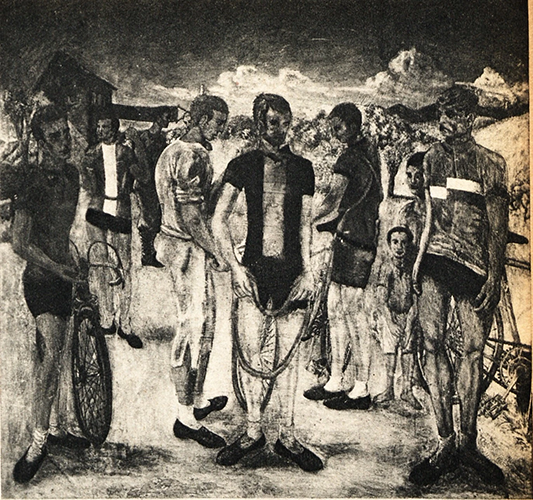



Aligi Sassu gives us a quick summary of how his cycling was an inspiration for the colours and forms in his pictorial experience
The light swishing of the rubber on asphalt, the smoky acrid smell of wet ground that the cyclist absorbs, the head lowered between shoulders bent over handlebars, the uneven road surface travelled in velocity, the dusty, steep and exhausting ascents under the sun – only those who have fought the long battle of the road can fully comprehend its poetry.
I learnt to ride a bicycle in an attic with my brother. A kid’s bike without any tyres that we found up there covered in cobwebs and bric-a-brac such as can only be found in an attic, and we fought over it desperately: then for years, I made do with makeshift bikes. I started to explore the world, gradually improving my equipment; first the bicycle frame, and then finally a long-awaited original Brow saddle. This is how I made my first excursions to the lakes and the Brianza, the first destination for Milanese kids who loved this sport.
In those days, Guerra was an up-and-coming star, Girardengo was still competing, but Binda was the true champion. Mara still astounded me for the arrogant determination of his racing; thrashing his adversaries with his flashing final sprints. I went to every start and finish line, and sometimes I met Tomea who went around the markets selling sweets and who had just come down from Cadore. Another time I managed to drag Manzù to Legnano to watch the end of a race, and I remember that when sprinting, Manzù beat all of us.
My brother and I both knew everything about cycling history. The ascents of the Cicognola, Mascolina, Madruzza, and the Bevera sprint. I loved the Ghisallo and Ballabio ascents, famous in all amateur Lombardy races; they hid no secrets for us anymore. I was quite good on the ascents and more resistant to fatigue than I was fast; as is said in cycling jargon, I was a late flagger.
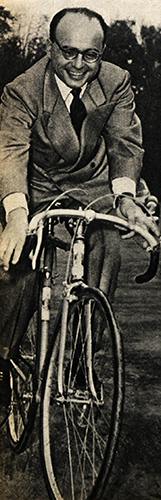
We would leave along the Via Emilia in the evening for Lodi with long and exhausting sprints to work on our respiration and practice our bursts. My first race finished with my withdrawal while in the lead because I fell when trying to tighten a pedal strap; I got caught up in the bicycle frame and collided head on with a road post at fifty per hour. My brother came in ninth and was disqualified for cutting the route. These results were not very consoling. I remember those years as a series of long dusty sprints along country roads, under the rain and wind because – being such aficionados – we would go out also in winter.
The amateur champion in those days was a certain Giovanni Rossi from Stradella. When he appeared at the start line, there was no hope; either for an early lead or a sprint, he always won.
Those excursions, the riot of coloured shirts and the speeding bikes was a fundamental contribution to bring me closer to nature, to the green Lombardy countryside, to the integrity of man.
The coloured shirts on those bluish or white-pink roads inspired me to express in my painting that vivid sensation of battle, of indefatigable feats of man, manifested in an open and loyal fashion.
I portrayed with epic contents a lyrical sense of being, of youth, of the discover of my inner being while my wheels whistled over the asphalt and the grey countryside gave way to the violet-streaked mountains and the white cloud-filled sky. Solitary hours in the heat of the Lombardy plains, in August when in the lakes, my travels to the Pian di Spagna and Valle Spluga were a continual invitation for active and rapid reflection. The world was still to be discovered, and still to be painted. Forms and colours created a vivid compendium in my mind, in direct and continual contact with the land and the sky.
And thus, little by little, my painting “The Cyclists” was born, tearing the colours and forms from velocity, the wind of the descent and the acrid dust of the provincial roads, and the sweat of an obstinate and unfortunate cyclist.