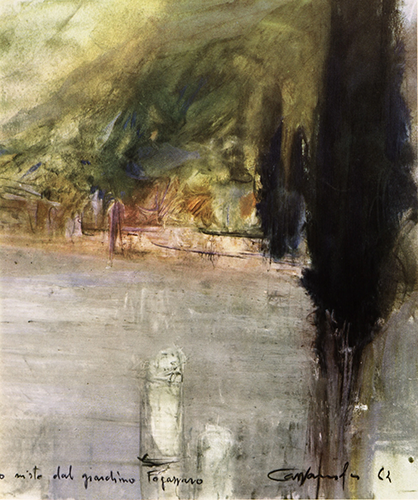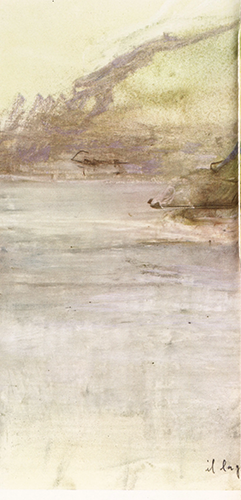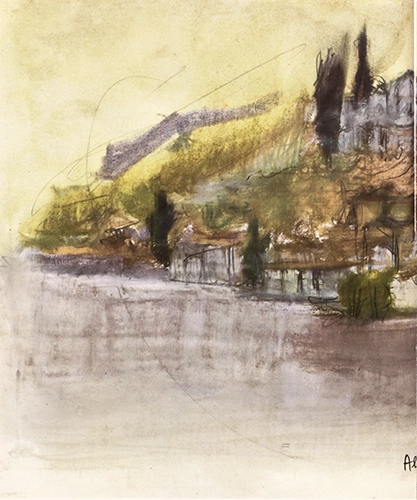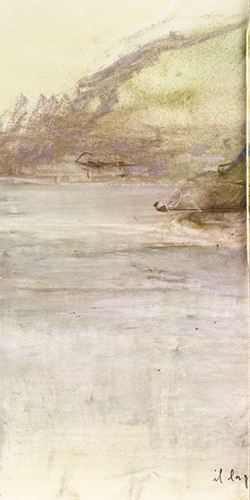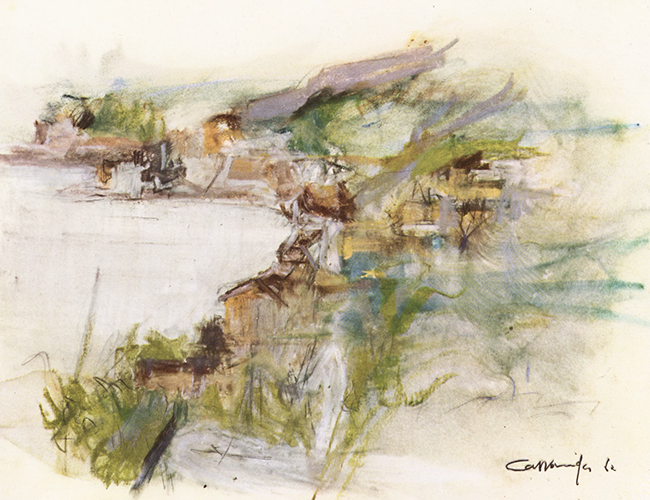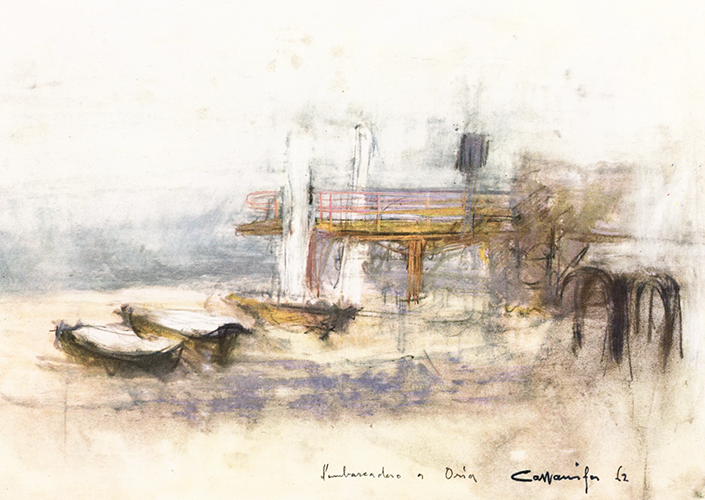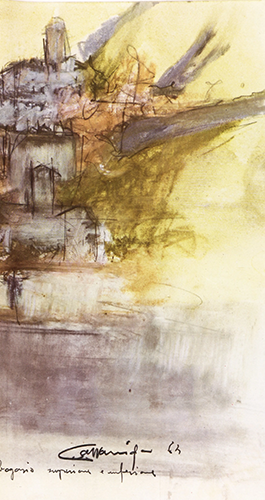



The little world that runs along the shores of the Lake Ceresio, to Oria and Porlezza, follows hills, scrub and little plateaus to the feet of the dolomitic rock formation of the Stretto Pass; it seemed ancient to Fogazzaro and still does today, although from the far-gone times of Leila, it has tried to keep up with the times. Enclosed by the Swiss border, by mountains and by rocky crests, that little world of the eleven “lands” evokes something of the “Cinque Terre” in Liguria, so isolated and cut off from the rest of the world. Only in 1913 was construction started on the road that today runs along the coast, but this lasted 25 years. From that road, another one branches off to climb up to Dasio. Little villages not reached by these two roads are still connected by ancient pathways that climb over rocky hills and wade through little streams.
On a Sunday, a driver can travel the entire road network of Valsolda in 30 minutes. Leaving Lugano and passing through Gandria on the border, after about 15 minutes of winding curves along the lakefront, the road goes through a tunnel just before Porlezza and leading into the Strada Tremezzina that takes you directly to Menaggio on Lake Como. If travelling from Lake Como, follow the westbound lake road to Menaggio, then take a left towards Tremezzina and follow the beautiful valley until Porlezza; it is a stone’s throw to reach the border of Lugano nestling in that humid green vegetation and the blue waters of the Ceresio, without even realising that you are in Valsolda.
Visiting Valsolda means to stop every one or two kilometres, leaving the car in some layby and hiking up the innumerable mule tracks; oppositely, you can climb down the stairs, passageways and along the porticos of the hamlets of Oria or Cadate to admire the lake view from the loggias, windows or balconies overlooking the waterfront and the green uninhabited mountains on the far shore.
Visiting Valsolda not only entails comprehending its historical and geographical unity which is easy to grasp, but also understanding its poetry through the works of Fogazzaro. As Recanati can be visited with a copy of Giacomo Leopardi’s Canti instead of a guidebook, the Valsolda too can be visited through Antonio Fogazzaro’s novels and poems. With such a guide, each village, house and landscape takes on another significance; this is not some form of literary intrusion, but the veritable attribution of significance to the landscape through the historical and practical decantation of Fogazzaro’s masterful writings. Here more than any other place one can talk of a landscape turned into poetry. Indeed, the names Oria, San Mamete, Albogasio, Cressogno, Puria, and places such as Villa Fogazzaro, the Nisciorée, Looch, Cressogno Peak, the port of Ombretta and others, must have evoked totally different sensations before Fogazzaro.
Under the heavy veil of Fogazzaro’s poetry the ancient Valsolda, proud of its history of free Republic still exists, tucked away in a remote corner of Lombardy; a small and well-defined region, grey with olives, black with laurel and cypress trees, and for centuries the birthplace for masters of arts, decorators, sculptors, plaster-workers, painters, and architects that left their admirable works throughout Europe; a Valsolda of artisans and country people in a minor key, with fishermen and boatmen too, hidden away in lakeside villages.
However, after the Vicenza-born Mariano Fogazzaro married his Valsolda bride-to-be Teresa Barrera, the destiny of this tiny region changed for good. The couple came to live in Valsolda, in the “Uncle Piero”’s villa. This was the birthplace of Antonio Fogazzaro, “TO WHOM AT YOUNG AGE UNVEILIED – THE DIVINE OF NATURE – IN THE AFTERNOON OF LIFE GAVE GLORY – AND AFTER EVERY BATTLE, PEACE”, says the epigraph dictated by Tommaso Gallarati Scotti and fixed to the side of the ancient villa.
After Little World of the Past, Malombra and Leila, as Linati wrote, Valsolda became “the Mecca and solace for souls in love, a secluded corner of dreams and poetry”.
The natural introduction to Valsolda is from Lake Como and Tremezzina. Arriving on this road gives the impression of reaching some well-protected refuge, peaceful and calm, populated by familiar and no longer mysterious shadows. After the curve of Cressogno where the Marquise of Scremin’s villa can be seen, the eye catches sight of the beautiful sanctuary of Caravina. Up there the entire Valsolda can be seen to the west, laid out in the sun between the mountains and the lake: “Its houses, its gardens, its little jetties all perched at the foot of the mountains that rise ominously with their vigorous peaks, forests and gorges” invite the viewer to stop for a never-ending and enchanting pause. “Let’s move on, but slowly” said Linati “because in little less than 30 minutes, we will have drunk in everything” of this little world.
And so we soon reach San Mamete, the main town in the valley, with its little sloping town square and its arcaded houses, many with loggias. Above, perched on a rocky spur, we see the village of Castello hanging over the sheer drop with its ring of decrepit buildings. From one of those loggias, the famous Signora Cecca watched over the entire Valsolda with her telescope.
A little further on, we reach Albogasio. The geography of Valsolda can still be identified by Fogazzaro’s topography: indeed, up there is the Palazzo del Pasotti (el bargniff), the church and the stairway.
In Oria we are still in the “delicate and quivering heart of Fogazzaro’s poetry”. This is where the poet lived, where his masterpieces were born and serenely immortalised in the pages of his early writings – very different from the mystical turmoil of his later works, infused by that fresh bucolic humour and pervaded by such precise descriptions of the places and people of his times that they still appear realistic even in such a changed literary and moral context.
If travelling to Recanati one takes a pocket edition of Leopardi’s Canti, we cannot imagine anyone visiting Valsolda with three or four copies of Fogazzaro’s works. Luckily, neither here nor in Recanati we can find walled plaques with phrases corresponding to each place. But who has not read Little World of the Past? The title already conveys the idea that a great writer from the previous century has set his novels in this hidden corner of the world, using its customs, memories, and characters to evoke its magic. Romantic events of tormented souls agitated by noble passions and great ideals are brought to life in this title: and if the literary memory of Fogazzaro has faded, we have fresher memory with films based on his works with Isa Miranda and Alida Valli.
The rare visitor admitted to Villa Fogazzaro and entering the poet’s study can still read some verses of Giacomo Zanella written in pencil on the doorway:
“In the many varied shadows and lights
cast by the sun on the lake and mountains
something never changes: the joyous expression
whenever a guest is welcomed”.
10 October 1865
A little further down and some fourteen years later – the 13 September 1879 –, the musician Coronaro penned a short musical verse, again in pencil and on two lines of the pentagram as wide as the door frame. Coronaro added the word “midnight” to the date to underline his participation in the romantic atmosphere of that moment.
In this little study – today occasionally used by Marquis Giuseppe Roi, great-grandchild of the Poet as he is the grandchild of Gina Fogazzaro (married to Senator Roi) –, everything is in order as if waiting for guests. On the writing table where many still-familiar pages were penned, sits a black telephone. One can imagine lifting the receiver, and without any ringing, hear not the voices of suppliers or friends of the Marquis, but those mysterious and far-away voices of Leila, Luisa, of Franco and the young Ombretta whose life was taken away by the waters below.
The Villa of Fogazzaro is not open to visitors, and only some rare scholars are admitted in search of memories; requests are few and far between. Once the popularity of the films Malombra and Piccolo Mondo Antico died out, their memories have entered into the shadows. Readers of Moravia and Pasolini whizzing past in their roaring “Alfetta” sportscars are oblivious to Linati’s advice: “Let’s move on, but slowly because little less than 30 minutes we will have drunk in everything” of this little world!
Somewhere worth visiting still today – but towards midday – is San Mamete with its shaded little square overlooking the lake. The Stella d’Italia Hotel loved by Fogazzaro has kept up with the times and today still welcomes demanding tourists either for a quick stop or to stay. It is still managed by the Ortelli family; the current owner, Umberto Ortelli, is one of those “upstanding men” who in Malombra receives Leila on her arrival in San Mamete with the little ferry boat, today still berthed next to the door of the hotel. Indeed, in the past the hotelier received Fogazzaro, and two signed letters of the Poet conserved in a showcase are proof of this. Guests look at these with disinterest when heading down to the beach with their coloured rubber rings or plastic snorkels.
Anyone wanting to discover more of Valsolda should depart from San Mamete by car to Dasio, directly beneath the crest of dolomitic rock. A kilometre before reaching the Alpine meadow, the traveller will reach Puria. A quarter of an hour from Puria, a beautiful path along the gorge of the River Soldo takes you to Castello. This will be the only remnants of an ancient network of pathways, as Castello is now to be reached by road from the other side. Indeed, a new branch is being built from Oria, passing through Albogasio Superiore, to reach Castello running along that ancient pathway precariously perched above the lake.
A morning, from 9,30 to about 12,30 is enough to cover the 7 kilometres of the lakeside setting of Little World of the Past and for an excursion to Dasio, Puria and Castello and vice versa, taking the traveller to those meditative places that Fogazzaro’s characters have left on those still sun-warmed stones.
Then go to Castello via Oria, taking the road to Albogasio and follow the road along the coast. At every corner there is a new view of the village perched above with the Cressogno peak behind, silhouetted in an empty light-blue sky. Groups of houses huddled around the church creep down the slopes between the greenery; every so often oratories dedicated to Carlo Borromeo can be seen, built around the time of the great Saint. Castello is one of those villages that can only be reached on foot; a village void of cars or motorbikes, and a true relic from another time. But the new road has already reached Albogasio and soon it will also reach Castello.
The afternoon hours are ideal for a stop in Lugano for those arriving from Lake Como, or for a quick visit to the Valle d’Intelvi for those crossing over from Lugano. From San Mamete, Porlezza is reached in a few minutes, and then continuing towards Menaggio and following the Riviera del Lario you can reach Como; or again from Porlezza, you can turn off towards Osteno and follow the shore of Lake Lugano. From Osteno you can see the entire Valsolda, as long you travel towards Lanzo. Lanzo has a veritable wealth of roads, panoramas and scenic spots which give the viewer an understanding of the labyrinth of water and valleys formed by Lake Lugano or Ceresio.
Another piece of advice for a nostalgic romantic: reaching Gandria, between Oria and Lugano, one can descend to the charming village clinging to the hillside and follow the Gandria Walkway. The Swiss – masters of tourism – have conserved and paved over some kilometres of that ancient pedestrian pathway leading to the Valsolda.
The Gandria Walkway is rather like that seafront path in Nervi, meandering through the cliffs and the rocky face above; but here the atmosphere is that of Fogazzaro, and is a perfect introduction to the dramatic symphony that will explode a little further ahead between the cypress trees and the oleanders of Oria.
It is pointless to say that alongside these pathways and along the entire coast and limited inland areas, the entire Italian and Swiss territory is dotted with new villas that will soon suffocate the Little World from the Past and the Little World from the Present with the undefinable atmosphere of a Little World from Modern Times. Between the olive trees, the laurels and the cypress trees there are many “For Sale” signs. The mediaeval statutes of the Valsolda rigorously prohibited the sale of land and the foreigners settling in the region. Today, however, the Valsolda opens its arms wide to people from Germany, France, Sweden, and Milan; parcels of land, division of property, dividing hills and slopes, villas, houses and jetties are built. Soon apartment blocks will arrive: Malombra Blocks, Ombretta Real Estate, Leila Real Estate, etc. Those little “upstanding men” will retire to Menaggio, Lugano and Como to enjoy their Valsolda land sold at 20,000 lire per square metre. Finally, the Celtic or Orobic etymology of that obscure name will become clear: that name sometimes written as Val Solida and sometimes Valsolda by ancient people, who were certainly unaware of the unromantic and feverish abundance of monetary gain that has reached and suffocated for the greater part its ancient and mythical splendour.