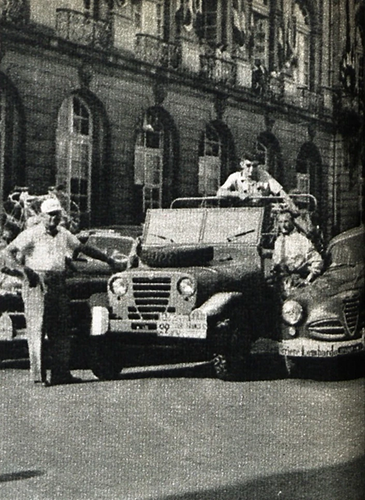



In this article, Alfredo Binda clarifies the reasons that induced him to participate in the Tour with the much-discussed “mosaic-team”
I have gladly accepted the invitation to write on the 1952 Tour de France for the Pirelli Magazine from the peace of my old home in Cittiglio. I have strong links to Pirelli through my long-standing friendship and the sporting work that we both share. I always return happily to this old house, to meet up with my aged mother Marta – now 83 years old – who gave birth to me in these walls, the tenth of fourteen children.
[…] In general two main charges have been brought against me: that I had put together a “mosaic-team” for the Tour that would not have worked; and that I stated publicly that I would have applied the sanctions authorized by the uvi [Unione Velocipedistica Italiana, the national association governing competitive cycling in Italy] on the basis of the carte blanche that they gave me, without my having request it.
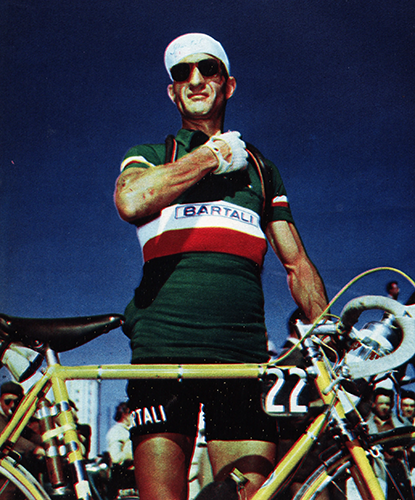
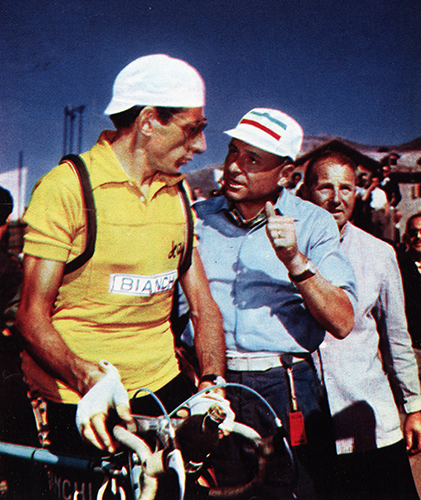
People will say – this I foresee – that it is easy for me to speak today in hindsight, after having had the honour and the pleasure of directing the team in France for a month, and after their successful results. On the other hand, I could not have risked losing the Tour just to satisfy my critics that they had hit hard and to the centre. They spoke about a mosaic-team; and if it was so, well be. But I knew that when the battle became tough, and the roads uphill, two men would be at Coppi’s side: that is, Bartali and Magni. By saying this, I do not want to make any negative judgement against the others; Carrea for example surprised everyone with some truly excellent feats. But still, at the beginning of the Col du Télégraphe climb – about halfway through the famous Le Bourg d’Oisans-Sestrières stage – when Coppi pushed forward, only Magni and Bartali were still part of the lead group. Having noticed that Fausto had a flat tyre, Magni didn’t wait until Bartali told him what to do, or until I arrived to give him instructions. In a couple of seconds, he reasoned that – not being a climber – it would have been better for Coppi to have Bartali with him further up the climb. When I arrived with the “Matta” [a service vehicle that followed the route of the Tour], I saw that Coppi had already started off again with Magni’s wheel. We can criticise the mosaic-team as much as we want, but if in that moment Coppi didn’t have Fiorenzo Magni next to him then he would have lost contact with the other lead cyclists and would certainly have had to work hard to catch up.
Let’s also say something about Gino Bartali, another member of that notorious mosaic-team. This was still on the Télégraphe climb, but some kilometres further on. I was comfortable when I saw Bartali and Coppi together, convinced that if there had been another puncture then Bartali would have been ready to do his duty. That day it wasn’t necessary and that day’s stage finished as we all know.
During the Sestrières-Monaco stage of the following day, the mosaic-team must credit itself – along with me for having put it together – with three significant events.
First episode. On the Colle di Tenda, the French team, in particular Dotto who was from that area, were to launch an attack on Coppi. I knew of their intention and had recommended that everyone keep an eye open in the long and difficult tunnel where the terrain was quite slippery and dangerous. There was no incident on that part of the road, and three of our team were in the lead group, ready to take on any of the adversary’s offensive: Coppi, Bartali, Magni, always the same three. After Breglio, having finished the fast downhill stretch, began the second ascent of the day, the Col de Brouis. Bartali was trailing Coppi and he shouted: “Fausto, you’ve got a flat”. Coppi stopped and Magni who was still there, gave his wheel to the yellow jersey without any hesitation. Coppi, accompanied by Bartali, caught up almost immediately with the lead group.
Second episode. Magni made a formidable sprint and caught up with the group at the Sospel checkpoint. A kilometre later, Magni has a flat tyre. This was his first, but in reality, the second time that he had to get off his bicycle, having given Coppi his wheel earlier in the race. Fausto was still flanked by Bartali and so the situation could still easily be won. Having completed the Col de Castillon ascent, the long descent towards Mentone started. After about 2 km downhill, Coppi punctured his tyre for the second time. Without any intervention from me, Bartali immediately gave his rear wheel to Coppi. This was the second episode of the mosaic-team, which until that moment seemed to represent the absence of any possible Italian victory in the Tour, but in actual fact it proved to be a true force.
Third episode. After receiving Bartali’s wheel, Coppi caught up with the lead group just before the end of the descent. At that moment, he was the only member of the Italian team present. Dotto and Nolten had already sprinted ahead. With another magnificent chase, Bartali caught up with them just before the start of the Turbie stretch, but in the last part of the ascent and after a sprint by Robic, he lost them as he was already exhausted from his previous effort. Coppi launched himself into the descent together with Robic. Once again, he was the only member of the Italian team. Then Coppi’s chain slipped from the sprocket and once again the athlete had to stop. Robic continued furiously in attack. When Bartali – who was lagging by a few seconds – came to Coppi and saw that he was stationery, he slowed down and waited for him and then they continued together to the end, taking turns in the lead and losing only 13 seconds.
I have dwelt at length on these three significant moments of the race to demonstrate to my amiable adversaries two things: firstly, when putting together the mosaic-team I knew that any inconveniences derived from rivalry between the three captains would have been amply repaid by their capacities and team spirit; secondly, I was convinced that I would be able to reach consensus through persuasion and reciprocal comprehension more than with that carte blanche that the uvi had given me and which I would have used only in the most desperate of cases, when no other means would have been sufficient. I would also like to add the following: I was convinced I would be able to reach a consensus: last year, when we talked about punctures, we discussed a detailed plan of action and how everyone should act towards Coppi and Bartali; this year this topic was not even broached.
In conclusion: it would be all too easy to form a team with only one captain if there was only Fausto Coppi in the Italian cycling world. Given that there was also a Gino Bartali and a Fiorenzo Magni, whose capacities nobody could doubt, I thought that all three had the right to participate in this great French event. Indeed, facts proved me right.
This Tour is finished, but I cannot say the same for my work. I now have the regional elimination trials of the “4th Gran Premio Pirelli” for which I – by request of the great Italian group – have been technical commissioner since its first edition.