



I grow old… I grow old… I shall wear the bottoms of my trousers rolled…
I’m getting so old… I can remember certain periods in Italian history that the youngest among us would find incomprehensible.
For example, there was a time (long before the Sixties) when we’d meet up for a beer somewhere or other and suddenly someone would mention Flash Gordon. At that point some members of the group (but only a few, only those who knew one another by sight) would look up, and one of them would throw down the gauntlet and say: “What was the name of the King of the Hawkmen?”. A momentary hesitation, but then the group of the elect would respond in chorus: “Vultan!”. The answer was correct (just think, in those days not even tv quizmaster Mike Bongiorno had arrived and, come to think of it, one of the group who played these games was Romolo Siena, the future director of Bongiorno’s popular “Lascia o raddoppia?” quiz show). We all loved comics. We all worked mostly on memory and few of us had collections at home. And those who did wouldn’t show them to the others. Or didn’t even know they had them until they came across them later in the attic. Around 1956 (or 1957) – I was working in cultural television programmes – I organized a show called “Qui comincia la storiella”, conceived by Vezio Melegari and directed by Pier Paolo Ruggerini. It was a review of the characters featured in the first comics, the ones brought to Italy by the “Corriere dei Piccoli”. I checked out the numbers from the various years in the Braidense Library (they had issues of “Topolino”, too) and I remember it was a real thrill to discover the existence of collectors. “There’s a certain signor Ferraro from Padua who has all the issues of ‘Jumbo’!” How? How did he do that?
Today collectors meet at the comics festival in Lucca, or pay for a classified ad in “Linus”. A collection of one year’s issues costs an arm and a leg, and speculators have moved in. I’m getting old, getting old…
Shall I part my hair behind? Do I dare to eat Miss Peach?
It was 1962. At a philosophy conference held at the University of Rome I spoke about the temporal structure of Superman comics. Participants included (the conference was on “demythologization”) French phenomenologists, German Dominicans and Dutch protestant theologians. They gazed at me wide-eyed with astonishment. The Dominicans and the Protestant theologians slyly purloined various items from my collection of albums, which I had brought along as documents, hiding them in the loose sleeves of their cassocks or in hardbacked ministerial folders.
When I published some semantic studies on comics in Apocalypse Postponed, the most supercilious critics stated that such frivolous arguments should not be tackled with cultural instruments commonly reserved for Kant. As if to say that the purpose of chemistry is to study perfumes but not dung, for which swearwords suffice. The first scholars of the phenomenon met almost clandestinely. Those who had discussed it even before then were thought of as bizarre journalists. Now, rightly, various university theses on comics have appeared, conferences are held, communications are discussed and I can no longer follow the literature on the subject. Sometimes I wish I could read a comic in peace without any problems. The boom of awareness has leapt over me in a single bound and I feel like a prehistoric relic.
In the room the women come and go talking of Charlie Brown…
“Linus” has made a breakthrough. Comics have become a national phenomenon, and a highbrow one at that. Make no mistake about it, “Linus” has done a meritorious job, it has taken an intellectual product of our times that we had been accustomed to think of as a mere by-product and saved it from a situation in which it was held to be of minor importance. But intellectual discovery has generated (and this is the fatal corollary to all cultural diffusion) a form of mass snobbery. We emerge from the catacombs with eyes still unaccustomed to the sunlight and those who until yesterday were sacrificing to pagan gods yell in our face: “Hey, why aren’t you going to church?”.
With the boom in critical awareness and the boom in the spread of the product, came a boom in fans.
Collectors two, academics nil. Conferences on comics are becoming mixed affairs in which psychiatrists who analyse effects and sociologists who make content analyses of the personalities of the characters alternate (without too many distinctions) with those wishing to speculate on rare issues. It won’t be long before the introductory remarks on the “Effects of caricature on the perception of physiognomy” will be made by Yosemite Sam. Once the battle has been won, perhaps it will be necessary to proceed to purges. Every revolution must devour its most incautious offspring. But sadly, by doing so it becomes institutionalized: from the committee of public safety you move on to the First Empire. I’m not exactly sure what would be the best thing to do. I’m getting old.
And should I then presume? And how should I begin?
How can we not be grateful to the publishers who have tackled the problem of antiques for the masses? This brings us to reprints, copies made from yellowing old originals and then distributed in the hundreds of thousands – a necessary operation that makes it possible to analyse characters and stories we could recall only vaguely. But the consequence is fatal: memory crumbles and reveals all its make-up and wrinkles. Like Dorian Gray, the idols of our reminiscences show their true face in the clear light of day. How boring Flash Gordon’s adventures were, how poor Pat Sullivan’s early drawings, how unsexy the all-American girls in the first “Terry and the Pirates”.
Of course, science also demands its victims and through the flaws in the best-known, “historic” products we can better understand their nature, and that of the society that consumed them. “Linus” had to print a whole lot of Li’l Abner before we became fully aware that Al Capp was no radical satirist but a Fascist to be ignored. Thank God, today we know all about our myths. And we feel all the sadder for that.
Should say: “That is not what I meant at all. That is not it, at all”.
Once people discovered what historians already knew, that comics are a medium of communication for adults, which chanced to be passed on to children, comics for adults began to appear in Italy. Since American cartoons for adults were read by kids here, their elders felt a need for stronger meat. This led to the birth of comics about crime and violence. Well, just for once I don’t feel so old. I feel like I’m interpreting the vital reason for the “young” cartoons of the past while rejecting Italian noir comics.
But I wouldn’t like to be misunderstood. Let’s not fall into the trap of moralism. Yes, I know, a boy murders his teacher, steals his money and then, bloodstained and still carrying the knife, he goes to the cinema, where he is arrested with a copy of “Diabolik” in his pocket. Deduction: reading “Diabolik” leads kids to kill teachers. Rubbish. If a kid is so daft as to kill someone and then go to the cinema still covered in blood, what do you expect to find in his pocket? Proust? But not even Nero Wolfe, who at least teaches you how to procure an alibi.
They arrest the murderer Cimino and find copies of Diabolik and Satanik in his hideaway. Immediately an indignant article appears on the arts page of the biggest daily in the north of Italy, signed by a winner of literary prizes, no less: see, those comics drove him to violence. Nonsense. In Cimino’s hideaway there was also a chess set. What is the link between chess and armed robbery? What’s a hunted killer obliged to lie low a for a few weeks supposed to do? Build a cyclotron and read Joyce? Crime comics are immoral because they are drawn badly and written worse. I have here an instalment with “Lola, the star of Diner’s Club”… We are at the level of myth worthy of “Cartoons for Dummies”. If you want to tell me a story about violent crime, do so. But do it well. If the drawings of Diabolik’s Jaguar car leave something to be desired in terms of perspective, the art teacher’s judgement is good enough for me: the product is no good (and I’m talking about Diabolik, the best of a poor bunch). With his Dick Tracy, Chester Gould tells blood-chilling tales, but the effect of the stylized drawings consigns the violence of the plot to a stylistic limbo of elegant graphic neurosis. Give your children “The Adventures of Jodelle” or “Barbarella” to read, they won’t become any worse than they are by reading scholastic anthologies and by commemorating our declarations of war. But don’t let them have the phony animal liberationists who churn out Walt Disney imitations.
But as if magic lantern threw the nerves in patterns on a screen…
But luckily the boom, the facility of opportunity and the growth of a new readership has permitted some talented people to recreate Italian comics that make a contribution to culture. I’m thinking of Enzo Lunari’s “Ghirigiz”, as good as the most renowned strips. I’m thinking of Guido Crepax’s visionary pop-up universes. Now that’s drawing for you.
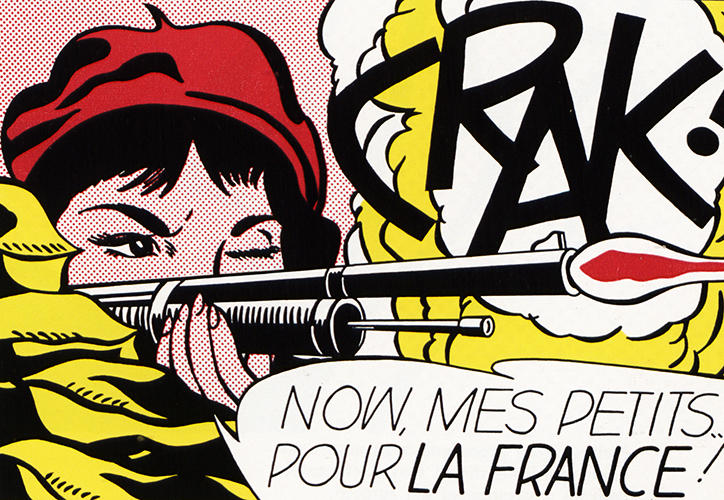
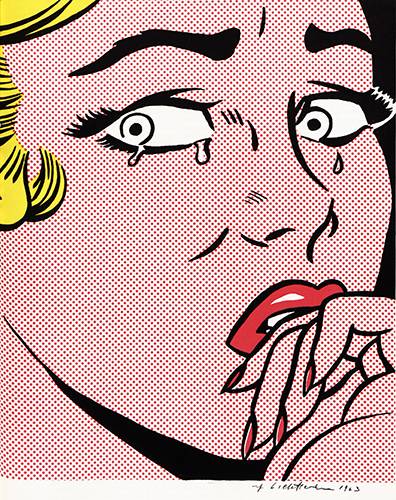
And so these new experimental comics have something in common with certain operations that have used comics to do things they weren’t originally intended to do, as in pop art. With Lichtenstein the comic becomes painting and both painting and the comic have been deeply transformed by this. It is a symbiosis that turns the tables on the figurative and on abstract forms, too. A society becomes aware of its own dominant images: it doesn’t matter if it does so with vigilant irony or with playful complicity. […]
I am no prophet – and here’s no great matter…
The fact remains that in exploding into the limelight the comic has turned the tables on itself. As soon as it is rediscovered as literature for adults, we are obliged to reappraise the opinion we used to have on its effect on children. […] Experiments have been made on how images are perceived and it has been seen that comics have not introduced an elementary and spontaneous language comprehensible only to children: Fabio Canziani has shown us that the smallest children really don’t understand when Goofy is angry, when Donald Duck is cross or when Cocco Bill is laughing scornfully. Understanding comics requires cultural training. Five years are not enough, you need a high school diploma at least. And it has also been discovered that the objection “comics encourage kids to look at the pictures and discourage reading” is facile, because in most comics (and there was a debate about this in Paris two years ago with Roland Barthes) the task of the image is to stress emotions and to lay emphasis on symbolic content, while the plot is conveyed by the speech balloons.
Regarding comics, a vast area is opening up for education and we know very little about children. That comics are bad for children is still in doubt, what is certain is that children are good for comics (all praise to Charlie Brown and his friends). We know that comic albums might be bad for adults, and they certainly are bad for adults who are so overly cultivated they don’t even grasp the basic grammar of comics and the cinema because they have spent their lives poring over books that they don’t see as an access to narrative worlds but as cultural fetishes deserving of almost religious reverence.
Only one thing is truly certain. That the comic as problem no longer exists. What does exist is the problem of comics. As if (except in philosophical discussions), rather than pose the problem of cinema, a society were to pose the problem of a choice between “Blow Up” and Abbott and Costello movies. Or in the novel, between James Joyce and Mickey Spillane. Or in painting, between Picasso and Carlo Levi. When it comes to comics we can no longer judge Sadik and Neutron, Feiffer and Tiramolla, or tough guy Dick Fulmine and B.C. as aspects of the same phenomenon.
This means to say, at least, that comics are no longer some kind of carnival sideshow, but a cultural phenomenon, provided we strip the term “culture” of the aura of unjustified prestige that a grand conception of human relationships had reduced it to and restore it to its more unassuming sense as a repertoire and system of the various ways in which a group and an epoch make themselves known (i.e. “communicate” themselves).