



Our land is distant, in the south,
warm with tears and mourning. Women
there, in black shawls,
speak of death in lowered voices
on the portals of the houses.
(from And suddenly it’s evening)
It has been a long time since I spoke with my homeland; thus, these lines could be a love letter inspired by a house or two, a seascape or a far-away beach. Words and sentiment have come to me little by little over the years, not only inspired by memories of a Grecian Sicily but also by a more ancient island, that of the Normans, Saracens and Spanish. Everyone has raised walls on this island, from its easternmost coasts to the west to shield against the free-reined winds of the Madonie, the Peloritani, the Iblei and Etna. Swabian, Arab, or Baroque walls; architecture generated by the southern sun and autumn, built by anonymous hands or bearing the marks of stonemasons; among them, how I desire to embrace those who have cast these whitest of images on the seas of Trabia. 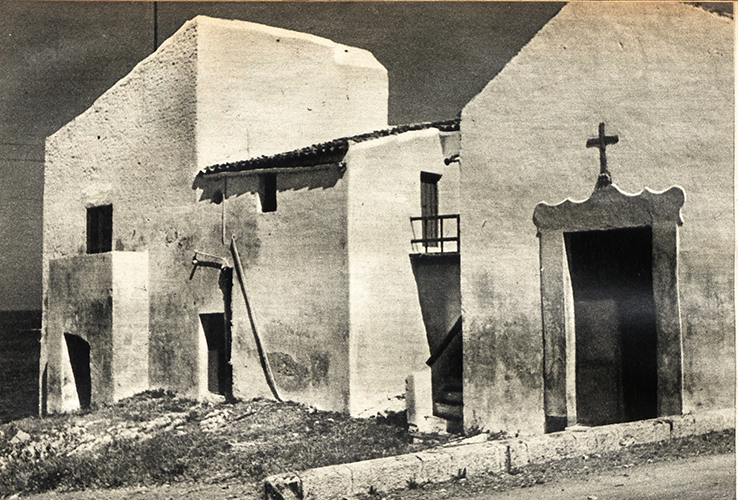 When landing in the lands of the Cyclops, Ulysses would have caught sight of a similar house sharply defined by sunlight and would have cried with joy at the reticular shadow playing before his eyes. Glimmering precious lines that have witnessed the passage of innumerable solemn and florid civilisations. One day, a man gets up from his makeshift bed of branches and goes in search for stones and lime. With a cheap folding rule in his pocket, in a waxed-paper covered notebook he drafts a “plan” for his house, scribbling notes, lines and numbers with an indelible pencil: he licks the pencil like a schoolchild. He is barefoot, broad-thumbed and with a thick head of black hair, but he knows how to build a steep-pitched roof. His architecture comes from his heart while he matches and aligns the corners with the trusses perfectly: he knows that the sun needs to beat on white walls to be mortified. No vaulted or rounded form interrupts the sharp lines: his eye measures the corners, his hammer slots perfectly into the stone. He is alone in his task: the mule carries the heavy stones and a young boy breaks them with solid strokes creating showers of sparks. Both worker and owner, architect and engineer, he keeps toiling for three or four months before the rains arrive and the sun becomes heavy, with no need to tally his hours. He makes some calculation on a squared page from his small notebook: 12 in a day multiplied by 100, 120. 144 dawns and dusks pass before a small flag is raised above the roof and wineglasses are emptied by friends in celebration of the new home. Rough sandpaper-like palms, a finger with a purple-bruised nail crushed by a beam (the nail will take longer to grow back than for the house to don its tiled roof), one day I had to search for you to hail my homeland in a strong embrace. It was no more than an image, a space delineated by volumes of light, a builder’s architecture which drew my attention to the hands of an anonymous islander. Perhaps it was my memory that evoked these simple yet precise forms inhabited by a Man who has been my companion and friend for millennia; my memory, tarnished by other objects and distractions. This is of no importance. The image of a foaming house gliding into the Trabian sea like a sailing ship was sufficient to make me enter, some kilometres offshore, a pebbled and thistle-lined path leading to Soluntum, a hill planted with columns, on a windy day together with many other young boys. But when, in this memory?