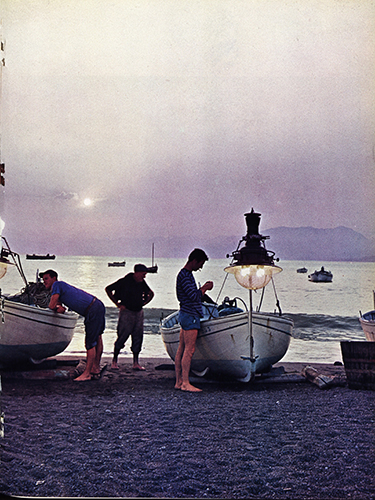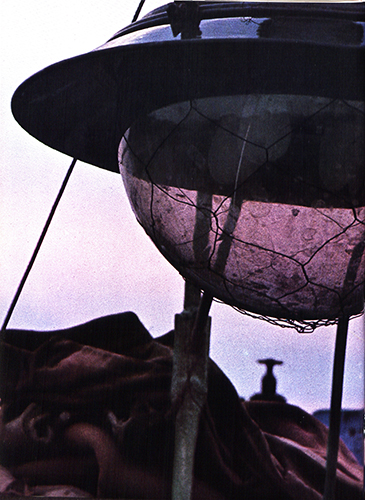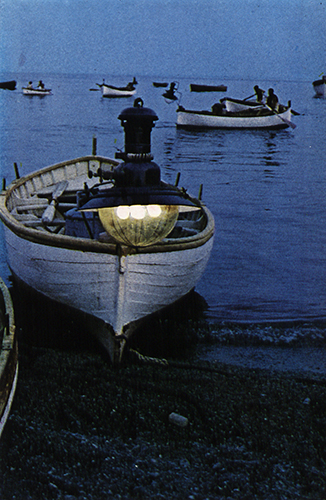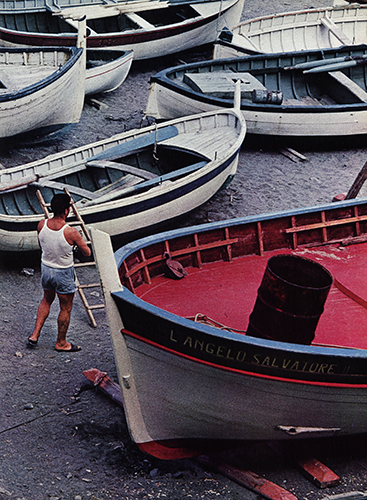



It is dawn, and from the Tyrrhenian and Ligurian seas to the Adriatic and Ionian seas the humid warm beaches have been abandoned by bathers. Now the fishermen with their utensils walk towards their boats and turn on their fishing lights, also known as lampare. The “look-out boat” is the first to go in the water; then the bigger boats with the equipment and the nets follow.
They stop in a close group just off the coast, then they throw the fishing net overboard and wait for the yellow light of the lampara.
Some people say that originally the word lampara was not the name of the boat, nor the fishing light, but the net. This is set out in a circle and kept afloat by cork buoys. Then two lines are pulled and together they lift the lower part of the net, known as the “letto” or bed: the fish get caught up in this sort of hood. It is said that this method was invented in Naples, by a fisherman called Matteo di Gregorio around 1830; for a long time, no lamps were used. Then they realised that the catch could be doubled by attracting the fish with light: and so this method became commonplace amongst fishermen throughout Italy, and then in France and later Spain.
On shore, the older fishermen prepare the crates of fish for market. Dawn has just arrived, and soon the squares will be filled with the shrill voices of the fish-sellers: the men that went out with the lampara now start their well-earned rest.