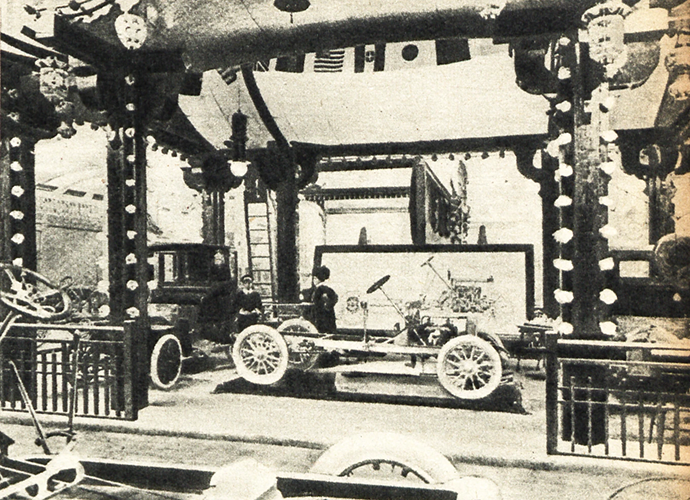



The earliest Automobile Shows were generally modest affairs, usually associated with some sporting event which gathered a certain number of new motorcars, helped also when these vehicles were exhibited after having competed on the road. For the first world Paris-Rouen race, the competitors’ vehicles were exhibited in the Rapp Gallery in Paris, where the public flocked to see them. That day – the 22nd July 1894 – was an unforgettable occasion, considered of such importance that it was covered by a New York Herald reporter who followed the event… on a bicycle; a truly heroic effort considering the 125 km course. […]
In 1895 a second exhibition was held for the Paris-Bordeaux Race. This event was of exceptional importance because no less than 39 automobile builders and 22 automobile accessories companies participated. This was not yet the customary format of the Auto Show, but at least three quarters of the groundwork had already been completed.
The United Kingdom was to follow in 1896 when restrictions for the free circulation of vehicles on roads were lifted. The event was promoted by Sir David Salomon to celebrate the famous London-Brighton route, and the competing vehicles were perhaps exhibited to convince the authorities that they were dealing with mere mechanical contraptions and not ferocious beasts thirsty for the blood of the public.
Further events were to follow and adopted a similar format as the advent of the automobile grew contemporaneously in those nations with a developing industrial sector.
Thus, Berlin in 1899, Brussels also in 1899, New York in 1900 just to mention the main events.
And what about Italy? Please accept my apologies if I speak about myself, but my life is so intimately connected to the world of automobiles that I feel obliged to do so.
When the Turin Auto Shows restarted in 1948, I proposed to number the Italian Auto Show events from the earliest onwards, but I was in two minds as to whether to start from the year 1899 or 1900. Indeed, in April 1899, during the week dedicated to automobile racing organised by my father – then President of the ac Torino – the 20 or so vehicles that participated were assembled in front of the Palazzo delle Belle Arti in the Parco Valentino to be exhibited to the public. This modest exhibition, however, did not follow the customary format of an Auto Show, as spectators paid no entry fee and the cars were still covered in mud honourably earned during their recently finished race.
Indeed, there were very few local visitors and for this reason I considered it best to start counting from the year 1900, when a true exhibition was launched, again following a week of sporting events organised by the A. C. Torino.
[…] The main hall hosted a series of beautiful French-built cars that had participated in the previous week’s events. […] In the other halls, some of the finest examples of Italian production were exhibited.
At the forefront was the recently produced “Fiat”, already splendidly forceful. […]
In the second row were “Orio” and “Marchand” vehicles built in the Piacenza-based factory of a certain notoriety; this factory would have profited more from its initiative if adversity had not struck, depriving it of its brilliant future with the demise of its animator Orio.
Michele Lanza was also present with a wide range of vehicles, each one representing a prototype of its own kind. […]
And then there was Ceirano with the “Welleyes”, the precursors of “Fiat”, and the little “Racca” vehicles. In addition to the Turin participants, the only Milan-based participants were Prinetti and Stucchi with their famous motorised coupled tricycles which, under the sure hands of Ettore Bugatti, would conquer an uncountable number of races.
For the accessories sector, many foreign participants participated but were represented through Italian agents. […]
This modest Show was a success and both the organisers and the numerous spectators were enthusiastic. […]
In 1901, Milan hosted the International Automobile Show as part of the International Sports Exhibition.
Sadly, the event was marred by very heavy rain and another misfortune: the car-body makers went on strike. In addition, those of us who were participating in the Giro d’Italia were engaged in our arduous task on the roads of the peninsula (about 1500 km), and so our vehicles were late in reaching the stands that had been prepared for their exhibition to the public.
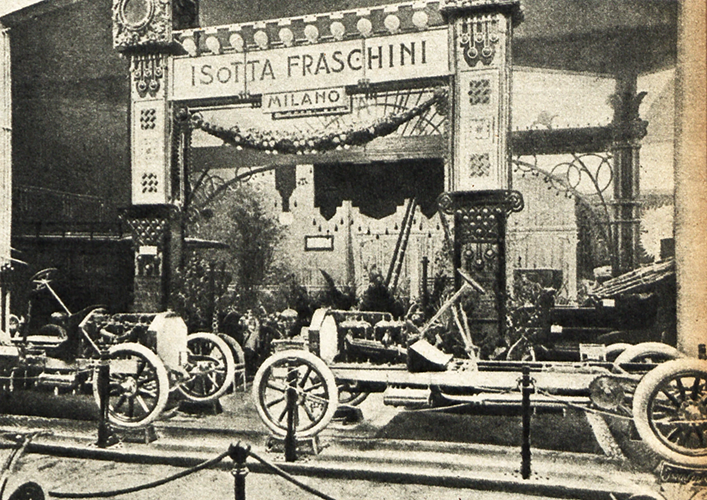
[…] The list of participants was long and comprehensive. From Reina and Zanardini, headlamps and sidelights to the faithful Oleoblitz, which was starting its brilliant career. “Oil as old as the automobile!” I think this is how the saying goes… From Prinetti and Stucchi, who exhibited their automobiles and tricycles, to Ettore Bugatti, who constructed his beautiful sporting toys – a little car that I remember well, and that already had many characteristics of the modern racing car. The Marchand brothers were at the forefront, then Giuseppe Ricordi, the father of Milan racing cars and ultra-dynamic representative of “Benz”, “Aigle”, of “Panhard” and “De Dietrich”. Also present was the “Florentia” and the “Richard”; Bonacini presented the carriage omnibus built by the Modena-based Orlandi, Türkheimer with the “Durkopp” engines. And then present in force, “Fiat”, already at the forefront, Rosselli from Turin, Bencetto, the Milanese Rivella, and again Isotta and Fraschini, which were to start their wonderful ascent.
And why was the Pirelli brand not yet present? In those years the company had still not consolidated its presence as a large-scale tyre manufacturer, although it was well known in other fields. It is sufficient to read the book dedicated to the company history to comprehend the difficulties that had to be overcome in setting up a factory for this activity. Indeed, the battle to forge a national and Milanese primacy in this field was long and arduous. In those crucial years, which were full of enthusiasm (those who experienced them were touched by providence), the ferocious battle between tyre manufacturers of all nations was at its height and would only calm later with the comprehensive division determined by the sheer volume of work that required team work.
I came across an advertisement published for the occasion of the 10th anniversary of the Paris Motor Show (1907) which states the following:
“The pneumatic tyre A is present with 1128 tyres; B with 681 tyres; C with 350 tyres; D with 314 tyres; and E with 138; F with 58 tyres. 63 other brands compete for a total of 218 tyres”.
And then another more truculent advertisement that sounds like a solemn war-cry:
“In the … Motor show, our brands represent 89% of all tyres exhibited…”.
This amusing battle of tyres continued ferociously and insistently for many years; indeed, it lasted until the glorious advance of our own tyres made it impossible to count how many of them were in use on roads worldwide.
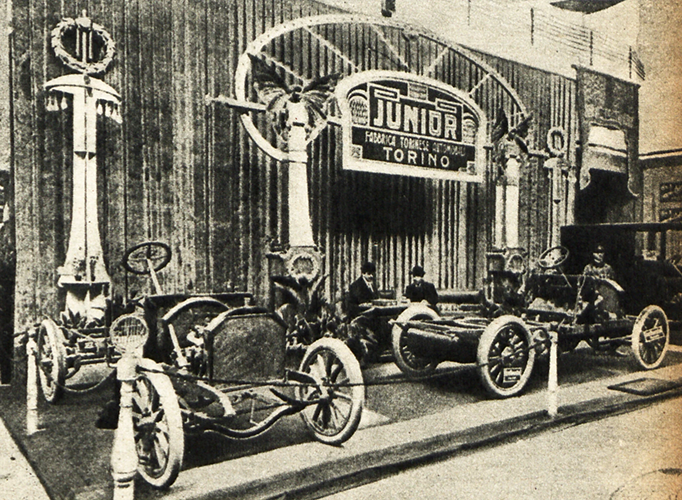
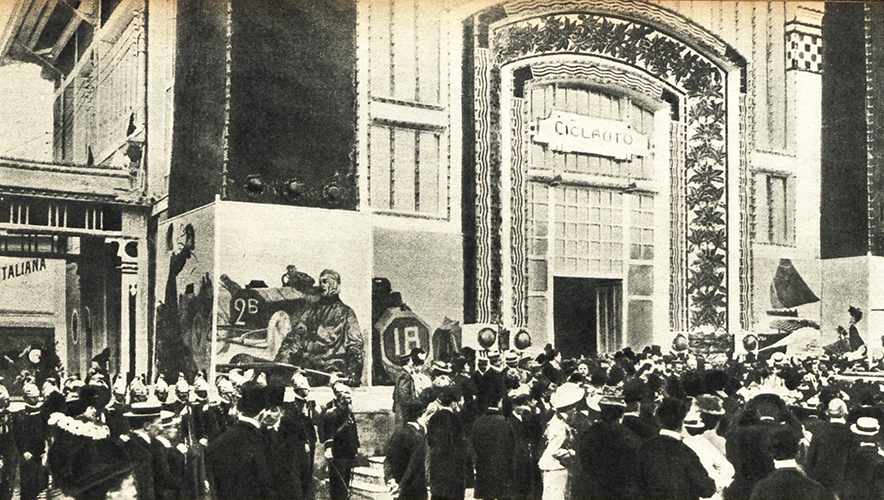
The Italian Shows had finally taken root and were becoming more beautiful and grandiose with every edition. This was a golden age: an age when the great manufacturers invested previously unheard-of sums in setting up their stands, so much so that at a certain point (perhaps it’s heretical that I say this) the costs were greater than the value of the products being exhibited. This was to continue until the annus horribilis of 1914, which saw the collapse of the world that we of a certain age had the good fortune to have enjoyed. To a certain extent, life had been serene, perhaps a little bland and monotonous, but imperturbable, placid and sometimes accompanied by that easy certainty that everyone would end their days in peace. Everyone would be able to leave their children or their children’s children with a home and an inheritance to ensure their future well-being.
After a long hiatus, the same climate returned, but in a minor key. And this time it was Milan that would guide the new start-up with courage and foresight. In 1920 on the bastions of Porta Venezia, a series of modest improvised parking lots housed some willing participants, but many of the big names were not present. This, however, was already sufficient to demonstrate that Italy was ready to throw itself full-heartedly into this new recovery, which was seen in the formidable progression of 16 auto shows (with the interruption of Rome in 1929), each more beautiful than the next, forming the second series, which concluded in 1937.
Then the arrival of another cataclysm, a second interruption. Had Italy decidedly stopped representing anything in the assembly of civil nations? Not at all. Italy has a thousand lives and has always risen from the ashes, despite all adversities. […]