



In an imaginary “logbook”, Piero Taruffi narrates the story of a night journey by car from Rome to Milan: driving problems, unforeseen incidents, simple and less simple manoeuvres on a long and eventful journey. The chapters of this unusual notebook could prove useful for many drivers on any type of road
I have had many opportunities to travel by road between Rome and Bologna. This stretch of road has a certain sentimental significance for me, because it evokes the years and the emotions of the Mille Miglia. I know this road very well, which is something important when you want to drive safely while maintaining a certain speed.
Naturally, I love driving fast, but for some time now I have realised that this is becoming ever more difficult with the increasing road traffic. When I want to drive fast, I usually do so at night. At that time, the traffic between Rome and Bologna – already scarce during the day – is almost non-existent. This also minimises any danger from approaching vehicles as they can be seen by the light of their headlamps, meaning that a reasonable speed can be maintained while respecting the highway code.
I have travelled this same journey in different types of vehicles, but every time I am always more concerned about the efficiency of the brakes rather than the power of the engine, and I always check that the tyre pressure is just a little above that recommended by the manufacturer, given that the last stretch on the Autostrada del Sole is quite fast. I prefer to have tyres with the tread uniformly worn to about 30-40%, as new tyres or older tyres with a very worn tread can be slippery, especially when driving on wet roads. If I think the vehicle is excessively understeering then I tried to correct this by increasing the pressure of the front tyres with respect to the rear ones, and vice versa.
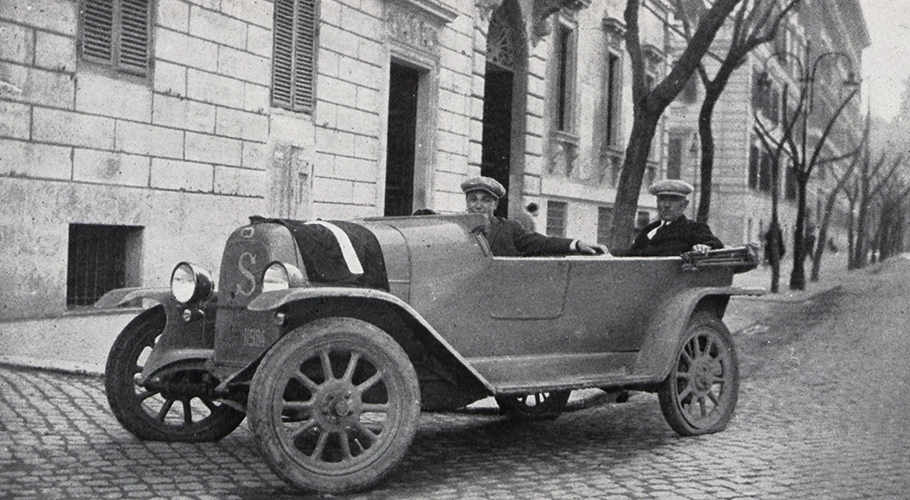 Leaving the traffic of the Rome outskirts behind me, after about 20 km, the road is deserted and visibility is improved due to the low concentration of houses. The road is rather winding but with some very fast turns, and to remain in my lane, I have to “cut” some bends in the road a little. Even at reduced speeds, I believe this to be a very useful technique: with a left-hand curve, I tend to veer towards the external border of the road when coming into and coming out of the bend and cross the white lane divider a little after halfway through the curve. At the same speed, the centrifugal force is less and consequently less friction is created on the tyres; this also causes less discomfort for passengers, lower consumption of fuel and less wear on the tyres. Obviously, I tried to travel these stretches within the speed limit, so I can brake or swerve without any difficulty.
If the road is clear, I take on the bend just before the quick climb of the “Merluzza” a little more forcefully. This bend offers full visibility and is free from any uncertainty factor. Taking this curve at a sustained velocity means starting the 3km straight climb with a greater momentum, which can save about 30 seconds.
[…] Between Sutri and Vetralla there is a tight bend which becomes even tighter towards the end. This type of bend is quite dangerous for the inexperienced driver. […] As I know this curve, in the first part I adopt a trajectory parallel to the centreline of the road and “cut” the curve only when the bend starts to become sharper.
From experience, I know that it is common to see carts and slow-moving vehicles just before Viterbo, so for greater safety I tend to reduce the velocity while maintaining the same trajectory. This means that I am able to stop if I meet vehicles travelling without headlamps, or when the road is entirely blocked by two passing vehicles.
I tried to maintain a constant velocity from the start, keeping up the same number of revs, about 10-15% below the maximum in the low gears, and near the maximum when in fourth. Due to my knowledge of that particular stretch of road, I find it easy to adopt the correct approach for each bend. Even before the halfway point and hypothetical “summit”, I progressively increase the acceleration and widen my trajectory, while reducing the movement of the steering wheel; this technique gives a pleasing driving experience. […]
My car has car seats that support the hips, so I don’t have to clutch onto the steering wheel and inadvertently alter my trajectory, nor do my passengers need to push with their feet or grab onto the handle above the car door for greater support. I am a firm believer in the use of “seatbelts”; these can be providential in case of tiredness, which is normal when driving at night. Before reaching Radicofani, I carefully prepare to tackle a hump which is immediately followed by a rather tight bend. A double danger! My car is equipped with powerful and efficient brakes. I have the chance to appreciate them in the descent from Radicofani, on which, some years before, and with other cars, I was forced to use the brakes with prudence: slowing down beforehand, scaling down the gears to reduce velocity, and limiting braking to allow them to cool down when changing gear. […]
After Siena the road becomes more interesting. There are numerous humps which must be tackled with care, and the best solution is to take them at a reduced speed, as some of these are also on curves. When there are no road signs indicating the direction of the curve, the surrounding countryside – trees next to the road and telegraph poles – can give some useful indication on the layout of the road ahead and I usually base my trajectory on these indications. […]
To my right, I see the first signs of dawn, and up ahead I can just pick out the outline of the distant hills. (This was propitious during the Mille Miglia trials: I was warned of approaching cars by their headlamps, and as the faint glimmer ahead grew stronger, it gave me some indication of the contour of the curves beyond the reach of my own headlamps).
Now the road comes to life with a certain vigour; a cart, a lorry and some cyclists on their way to work. I reduce my velocity even more when approaching sharp bends. I reach two lorries tail-to-tail just before a curve and so I slow down to maintain a certain distance between my car and the first part of the curve and start to accelerate out of the curve when I have full visibility of the road ahead. I see an oncoming lorry about 300 m ahead, but already having accelerated, I decide to overtake, a manoeuvre that is completed comfortably. I reach Florence as the sun is rising; the city too is beginning to wake up, and I make it just in time to get onto the motorway with the rising sun behind me. I start my timer. My driving picks up pace and I don’t change gear any more as there are no oncoming vehicles. My only worry is that the cars in front of me won’t keep to the right-hand lane to let me overtake. I have to evaluate their speed and movement, as they sometimes indicate that they will overtake only after having started to move into the left lane, which is a very dangerous situation indeed! With this rash manoeuvre in mind, and aware that my speed makes being overtaken improbable, I still look in the rear mirror to check if it is positioned correctly. To indicate my intention to overtake, I flash my headlights from a fair distance, hoping to attract the attention of the driver in front, and when I get close, I give a brief honk of the horn. I slow down to observe the architecture of a great flyover, and then I reach the same speed as before. My vehicle covers the road at great speed, as if on a railway track. I don’t attempt to “cut” bends any more. […]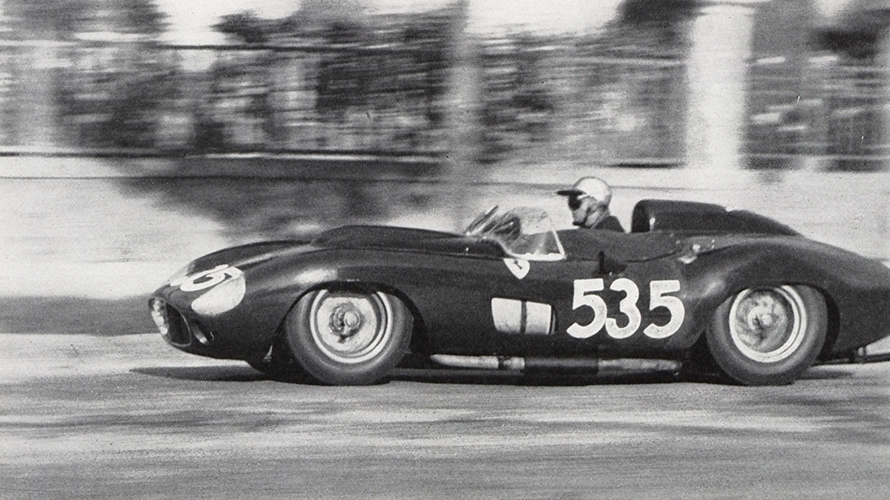
I feel like I am in the observation car of the “Settebello” high-speed train and when I change lane to overtake, it is like changing tracks when entering or leaving a railway station!
I reduce my velocity slightly before entering a tunnel due to the possibility of the road being wet from infiltrated water, and when exiting the tunnel, I hold the steering wheel firmly, ready to react against any gusts of wind, which are quite common in that part of the motorway. Wind usually blows from the right, and therefore before exiting the tunnel I tend to move towards that side of the road. Upon arriving in Bologna, I check the time I took to complete the last part of the journey. I demolished, almost halved the record that I had made in the Mille Miglia with my high-powered racing car: but then again, for that event I travelled to the Trident City [Bologna was home to the headquarters of Maserati and its emblem is a trident] via a winding road that crosses the Apennines, through two mountain passes, the Futa and the Raticosa!
My passenger starts to wake up even while I start to feel sleepy. I know that sleep hits you like a thunderbolt, and this has happened to me in the past – fortunately with no serious consequences – some years before in these parts. Twenty minutes of rest, a quick wash of my face and a nice strong coffee give me sufficient energy to take on the last part of the motorway to reach Milan. I travel at 85% of the maximum speed limit of my car, which is an economical, fast way of travelling, and above all, is easy on the engine.
But after finishing this journey I convince myself once and for all that for whomever really likes driving which is fast but free of danger for themselves and for others, the only solution is to drive on one of our racing tracks.