


In order to win the 1951 World Championship, Juan Manuel Fangio spent over two years in Europe and morally committed the prestige of Argentina. This clearly demonstrates that the Latin American sporting idol did not take the matter lightly and achieved his goal with all means necessary, demonstrating at the same time patience, perseverance, and commitment.
I think that Fangio himself would be pleased by this introduction. Fangio has always focused on three essential objectives in his life and sporting career: the first has already been noted; the second is his respect towards our drivers and automobile manufacturers; the third is his devotion for Perón and his admiration for Argentina, but also for his very Italian heritage.
With his good humour, patience and intelligence, Fangio is well prepared to take on sacrifices that most people cannot comprehend nor clearly evaluate. First and foremost, the rivalry of highly skilled adversaries, four in particular: Ascari, González, Farina and Villoresi. It could be said that Farina is his teammate and González his close friend, but when racing, these prerogatives are valid only up to a point, as is demonstrated by Ascari and Villoresi, who have fought to the bitter end, despite their close ties and sentiments. Fangio first had to convince Alfa Romeo’s mechanics, managers, and drivers. In 1951 he was undoubtedly more fortunate than Farina, but during the previous year it had been a completely different story. In the seven trials leading up to the World Championship “El Chueco” consistently logged up the fastest times; he gave lessons in style, in calculated impetuosity, in intuition. He went on to win three competitions (Swiss Grand Prix in Bern, Grand Prix d’Europe in Reims and the Spanish Grand Prix in Barcelona) and became acquainted with the irony of fate in Spa, when he could already consider himself absolute first or second in the Belgian Grand Prix.
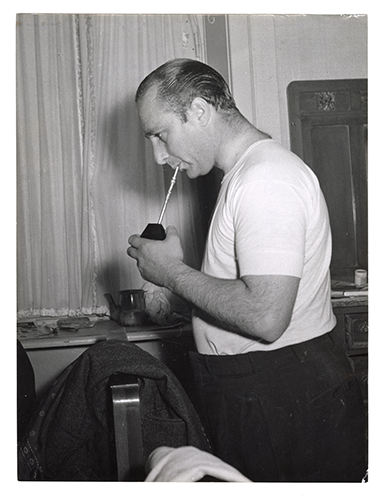
The calm and meticulous nature of the Argentinian driver reveals some peculiarities. Fangio weighed 92 kg and decided to lose some weight to improve resistance during the long distances, to hone his reflexes, and to be more agile in the cockpit. He convinced his friend González (who lived with him in Galliate in the villa of the late Achille Varzo) to follow a special diet and to do a lot of gymnastics, and they both bought bicycles. Every morning Fangio would undertake longer and longer runs, even reaching 100 km, and slimmed over 7 kg in a few months. González instead remained steady at 98 kg, in part because he fell and injured his ankle. In Barcelona “El Chueco” tried to keep his movements to a minimum in the cockpit so as to not wear himself out. In the evenings he studied the most difficult parts of the track and during the trials, he had already tackled some of the curves, taking them wide or narrow, and thinking over the race and the various outcomes: where to tail, where to sprint or overtake his adversaries. Furthermore, Fangio also promised to give up smoking, and he succeeded.
[…] Manuel […] wasn’t cut out for country life and so started out as a mechanic in the workshops of Miguel Viggiano. This was the start of one of the most extraordinary careers of our century, as incredible as a story from a novel. Although he began by getting his hands dirty in car engines, Juan Manuel preferred football and played centre field. But he had chosen the right road with Viggiano and at the age of 18 he took the first steps of his career as a driver. He teamed up with his employer as second driver in the Buenos Aires-Rosario event and later in some other races, but he had to enlist in Artillery School, and only after some time did he return to Balcarce. He set up his own car-service company, “Fangio, Duffart and Cavallotti” and in 1934 he participated in his first races, now solo and in a Ford lent to him by Bianculli. The rest is well known. With Fords and Buicks owned by his friends and which he himself prepared, he stepped up his activity, and then started and continued to win with Chevrolets and other brands. In 1940 in the Argentinian Grand Prix (the Buenos Aires-Lima-Buenos Aires) he was confirmed number one in a fast-growing automobile scenario and presented himself with an almost domineering energy. His successes in 1941, in particular in the Vargas Grand Prix Vargas and the 1942 Argentina Mille Miglia, were his consecration to the racing world.
After the war, his victories on the circuits of Pringle and Rio, and the Grand Prix wins in Buenos Aires, Montevideo, and Rosario elevated Fangio to the level of an idol. He took a break in 1948 to prepare for an authentic European expedition. In 1949 the champion’s roll of honour was enriched by the following successes: Buenos Aires Grand Prix, Trofeo Wimille, Mar del Plata Circuit, Perpignan, Marseilles, Monza, and Albi Grands Prix and many other classifications. In 1950 he won the Pau, San Remo and Monaco Grands Prix, the Remparts circuit, the Belgium, France and des Nations Grands Prix as well as the Pescara and Silverstone Grands Prix, and then in 1951 three World Championships and the Bari Grand Prix, without listing many other hard-earned and admirable victories.
On his departure, Fangio left Europe with the certainty that he was a true international champion, worthy of Varzi and Wimille, whom he considered his maestros; and indeed, he resembled them both in style and temperament. He left many with the conviction that he was the finest driver in the world together with Ascari, whom Fangio singles out for the future of the sport.
Fangio will return in spring and will rest for the winter, but only until January. He will then participate in competitions on the new racetrack of the capital, and perhaps in February in Uruguay. But in the meantime, he will reorganise his import-export, sales and car-service company: Bernardo de Irigoyen Street 1315, Buenos Aires.