


We don’t know when and where painting on glass (it would be more appropriate to say “under glass”, because the painted plate, which was framed in such a magnificent way, actually showed the other side, thus the painter worked in a reverse manner with a xylograph engraver or an etcher) began in Europe. Experts say that it was already happening in the 17th century, and you can find examples in some collections. But it certainly exploded in the 18th century, as part of that wonderful movement that “debased” art in terms of the nature and materials of objects used.
Painting on glass is basically a “tactile” invention. The brushstrokes are usually quite humble. They get richer as they are incorporated into the glass, taking on light, reflections, intensity, brilliance, and a mineral quality, almost as if the colour was an archaic emanation and crystallisation, resulting, miraculously, in the image. It is considered folk art. […] But in its origins and first uses, painting on glass was anything but folk art. In Sicily, for example, the hypothesis was rightfully formulated that “like in other European countries, the custom of painting on glass was established in aristocratic culture between the end of the 17th century and beginning of the 18th century”; and “the notable difference in style and content in painting on glass in the 18th and 19th centuries” can be explained by the fact that “lacking a rural petite bourgeois, the artisan lived in the shadow of the wealthier classes”, while the “slow transformation of the social structure and resulting development of a middle class, a new type of craftsmanship came about that imitated, as new classes are wont to do, the cultural models of upper classes, but following the dictates of the traditions of the people, with this new class and the artisan remaining strongly linked” (Antonino Buttitta, Cultura figurativa popolare in Sicilia, Palermo 1961).
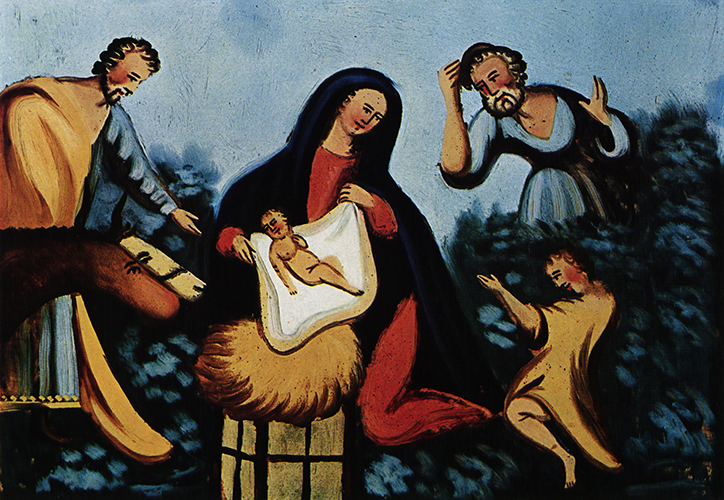
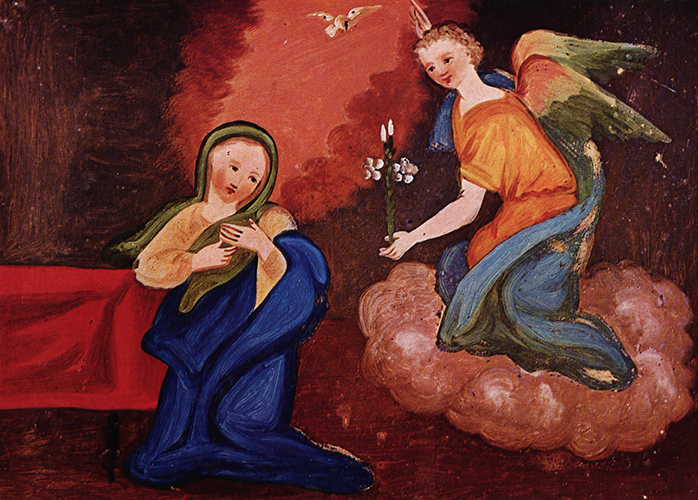
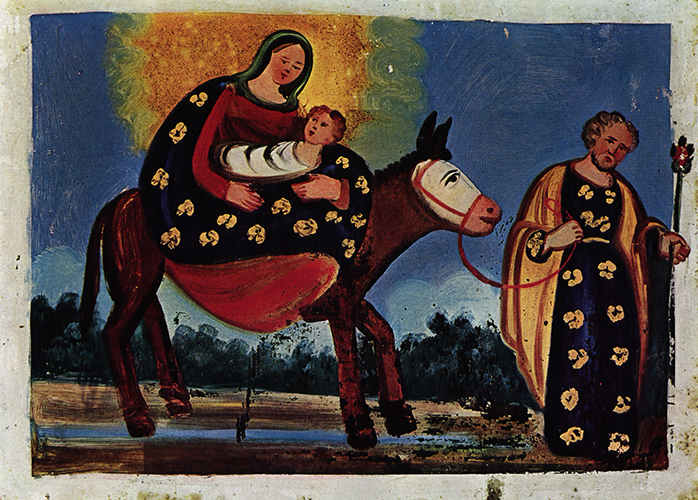
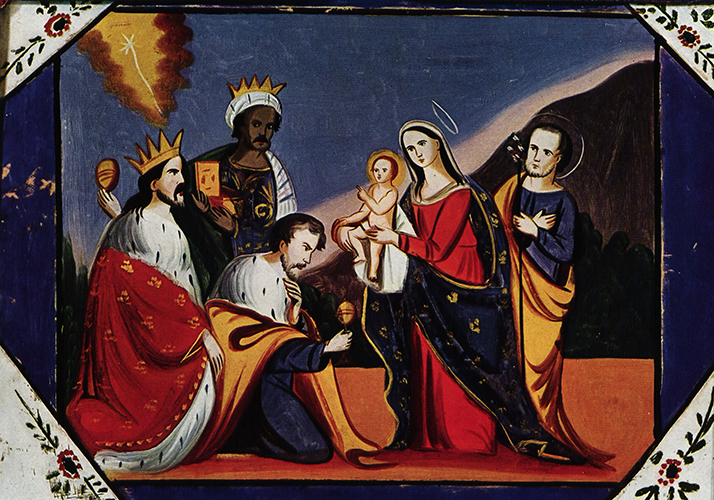
Therefore, painting on glass was not strictly meant as folk art. At least in Sicily (and possibly elsewhere, considering that there are many pieces in a Polish museum which are quite curious, given that similar paintings were said to be secret vessels for money). At a certain point, between the end of the 18th century and the beginning of the 19th century, these types of pieces entered into the homes of the middle classes, in other words, the wealthy farmers and land-owning farmers, but never into the homes of poor farmers or day labourers. We have proof of this in the descriptions from academics and writers from the 19th century of the homes of “peasants”. […] As previously mentioned, paintings on glass included frames of some value, while “peasants” lived in conditions of extreme poverty, and they rarely had money from their sporadic work at harvests. At least two-thirds of their pay was deducted to cover the food that the landowner gave them in advance to support their families (that money also went to pay the growing interest that these advances included). Despite the impression one might have frequenting flea markets in Palermo where paintings on glass seem to surface frequently (though experts rarely make any good discoveries these days), production during the most popular period was not only limited but local in nature. In eastern Sicily, there were very few and the ones that existed came from the main production centres on the western side of the island, which would have been between Palermo and Trapani. The presence of certain patron saints on them – or the absence of others – can help narrow down where these centres were. For example, there are quite a few of Saint Rosalia, the protector of Palermo, while there aren’t many of Saint Agatha, to whom residents of Catania are devoted. There are rare examples of the most famous three saints – Alphius, Cyrinus, and Philadelphus, who had and have a cult-like following between the provinces of Catania and Syracuse; Saint Calogerus is missing, and he is the patron saint of no fewer than seven towns in and around Agrigento, including the main city itself. This attempt to narrow down where these paintings were created is not contradicted by the lack of a great presence of Saint Lucy (Syracuse) and Saint Michael (Caltanissetta): among the celestial hosts, the former has special healing powers in her eyes and is, therefore, found in every Godly place; the latter is handsome, strong, armed, and has always been invoked against temptation. The most common themes are the holy family; the sacre conversazioni; the sacred family along with the saints; the nativity; the flight into Egypt; the Madonna with child (sometimes seen as the patron of a certain town); Jesus, the good shepherd (or Young Saint John); Saint Joseph; and Saint Rosalia. Biblical topics are also taken on. One common theme is the conversion on the way to Damascus. This confirms that this type of painting was not necessarily folk art because the events of the Bible were not well-known among common people […].
For the entire 18th century, and perhaps until the beginning of the 19th century, talented and famous painters took up painting on glass; and this technique would not have been widespread among artisans, if a painter of mediocre talent yet extreme arrogance such as Giuseppe Velasco (who painted the frescoes in the Sala d’Ercole, today home to the splendours of the Sicilian parliament), dared associate his name with a few paintings on glass, signing, with unparalleled modesty, as Velasquez. But the so-called “cultured” style of painting on glass doesn’t interest us much. It is when it becomes folk art that we start to take interest. And it could be said that here a curious phenomenon takes place: on an “artistic” level, painting on glass is quite impersonal, and is generically classified by theme or subject more than the quality of the execution and style[…]; but on an artisanal level, not only is it possible to classify a piece as French or German or Slovenian or Sicilian, but for those with a certain familiarity with the local style or those who have the opportunity to look at a series of even just a few pieces, it is possible to identify common elements in two more or more paintings. As, for example, the same pattern, the same tone, or the same handiwork. Perhaps it is just an impression, but there are two or three veins that run through Sicilian works from the 19th century and that are easy to see throughout the various collections. There are two or three outstanding painters who can be identified stylistically. Naturally, we don’t know their names. And that is a shame. It would be wonderful to recount the lives of these artisanal glass painters, or to reconstruct them the way Jean Giono did with Charles Frédéric Brun, known as the “deserter”, a simple, poor painter like his Sicilian contemporaries. They painted vividly on glass with scenes that included the nativity, the flight to Egypt, and the passion of Christ along with glorious images of holy warriors and martyred saints.